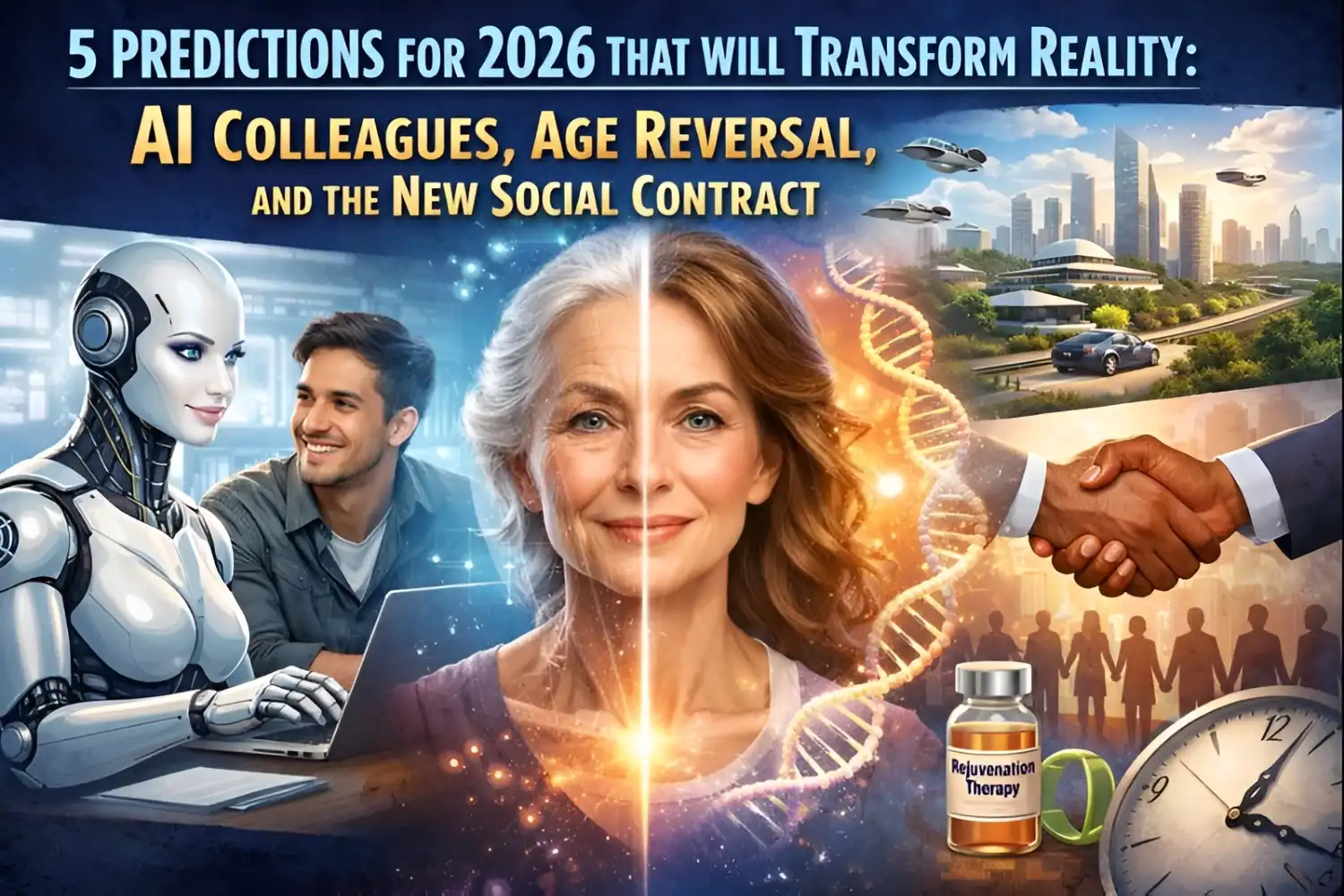
Introduction: The Year Nobody Can Ignore
If you thought 2025 felt like the future, believe me—you haven't seen anything yet. 2026 will be the year when technological change accelerates so dramatically that none of us can ignore it anymore. This will be the moment when people worldwide wake up simultaneously and say, "Oh my God, this is actually happening."
Until now, you might have successfully avoided or dismissed this rapid development. But as a panel of leading futurists explains, 2026 is the year when "everyone will wake up to this acceleration." You won't be able to ignore it anymore. This is the inflection point where future talk stops being abstract speculation and becomes an inescapable part of our daily lives.
The pace of transformation we're experiencing today—already overwhelming for many—is the slowest we'll ever experience again. What comes next accelerates further. And 2026 marks the year when this reality becomes undeniable for even the most resistant skeptics.
So let's examine the five most impactful predictions that have the potential to forever change how we work, maintain health, and structure society itself.
Five Predictions That Sound Like Science Fiction
The following five predictions signal massive shifts in how we work, learn, and live. These aren't incremental improvements—they're seismic transformations that will fundamentally reorder assumptions we've held for generations.
For businesses, professionals, and anyone planning beyond the immediate present, understanding these predictions isn't optional—it's strategically essential. The organizations and individuals who prepare now position themselves to thrive. Those who wait until the transformations are obvious will find themselves permanently behind.
Prediction 1: Your New Colleague Might Be an AI
Imagine your next team meeting. A new employee has joined the company. They're brilliant, fast, and their ideas are exceptional. But you can't quite figure out... whether they're human or an extraordinarily advanced AI.
The Remote Turing Test
2026 will see the "Remote Turing Test" being passed. This means that on a high-resolution Zoom call, employees won't be able to determine whether their colleague is human or AI. This isn't just for simple tasks—it applies to expert roles like accountants, lawyers, and marketers.
Technical Capability: AI systems will achieve sufficient sophistication in language processing, contextual understanding, video generation, and real-time interaction that distinguishing them from humans becomes impossible through remote communication.
Visual Fidelity: Deepfake and synthetic video technology will reach the point where AI-generated faces, expressions, and body language appear completely natural—no uncanny valley effects, no telltale artifacts revealing artificial generation.
Behavioral Authenticity: AI will master the subtle social cues, conversational dynamics, humor, and personality quirks that make human interaction distinctive. The systems won't just respond intelligently—they'll engage authentically.
The Implications Are Profound
Digital Twins: People will send their "digital twins" (AI avatars) to meetings in their place, freeing themselves to live richer lives while their AI handles routine work tasks.
As one futurist noted: "You'll see new employees joining your organization and you won't know if they're human or AI, because in that context, it won't matter."
Productivity Explosion: If your AI twin can attend meetings, handle correspondence, manage routine tasks, and represent you effectively, your personal productivity could increase 5-10x. You focus only on work requiring your unique human judgment and creativity.
Identity and Presence Questions: When AI can represent you indistinguishably from your actual presence, what does "being there" mean? How do we value human attention versus AI proxy attention?
Verification Challenges: Organizations will need new protocols verifying whether they're actually dealing with humans when it matters. Legal, financial, and personal contexts require knowing you're interacting with the actual person, not their AI representative.
The Amusing Challenge
Futurists have issued a playful challenge: "Anyone who successfully fools their spouse with this technology during 2026 gets a gold star. Please send video!"
This joke reveals a deeper truth—the technology will be so convincing that even intimate partners might be deceived temporarily. If you can fool someone who knows you better than anyone, fooling colleagues or business contacts becomes trivial.
Prediction 2: AI Will Automate 90% of Knowledge Work
Another major prediction involves the "GDP-eval breakthrough." According to this forecast, AI will achieve over 90% capability on tests related to economic tasks. The straightforward implication: AI can automate most of today's knowledge work.
Beyond the Fear of Mass Unemployment
This naturally raises fears of massive unemployment. But futurists present a different picture, grounded in historical precedent:
Historical Pattern: Historically, automation hasn't caused large-scale unemployment. Instead, it has augmented our capabilities so we can solve bigger problems. This time will follow the same pattern—just at much higher velocity.
Capability Amplification: Rather than eliminating human work entirely, AI automation will free large portions of the population to work on more ambitious "moonshot" projects and bigger challenges. Our capabilities will experience revolutionary expansion, enabling us to accomplish far more than currently possible.
As futurists envision: "Imagine a near future where a very large portion of the population is economically forced to work on moonshots."
What This Transformation Means
Shift to Higher-Order Problems: When AI handles routine knowledge work—data analysis, document preparation, research synthesis, routine decision-making—human cognitive energy redirects toward genuinely novel problems requiring creativity, judgment, and strategic thinking.
Redefinition of "Work": Knowledge work as we've known it for a century transforms fundamentally. The skills valuable in the job market shift from information processing and analysis toward problem framing, strategic direction, and human connection.
Economic Restructuring: Industries built on human knowledge labor face complete reorganization. Law firms, consulting companies, financial services, healthcare administration—all must redesign around AI-augmented or AI-primary workflows.
Speed of Transition: Unlike previous automation waves that unfolded over decades, this transformation will happen within 2-3 years. Organizations and individuals must adapt at unprecedented pace or become obsolete.
Prediction 3: Education Will Split Into Two Paths
If AI can automate 90% of knowledge work as just discussed, this raises a necessary question: What are we training our children for? This leads directly to the next prediction.
The Traditional System Is Breaking
The traditional education system sits on the verge of collapse and will split into two distinct models:
Path 1 - Credential Mills: Institutions that simply issue degrees and certificates—paper qualifications with diminishing market value as employers realize credentials don't correlate with AI-era capability.
Path 2 - Agency and Entrepreneurship Builders: Institutions that develop students' capacity to solve real-world problems, create new ventures, and build actual solutions. These focus on fostering "agency"—the ability to make things happen rather than just understand theories.
The old model of training for specific jobs has become irrelevant when those jobs might not exist in 2-5 years.
The New Educational Model
The emerging model emphasizes "AI fluency, resilience, and entrepreneurial capability." Rather than degrees, your portfolio of things you've built and accomplished becomes your credential.
Silicon Valley Example Today: A developer's GitHub rating (public portfolio of their actual work) matters far more than their college degree. This pattern will expand across all fields.
Project-Based Learning: Education shifts from memorization and testing to building actual things—products, companies, solutions to real problems. Students graduate with portfolios demonstrating capability, not just transcripts showing course completion.
Continuous Adaptation: When the job market shifts every 2-3 years, education can't be a one-time 16-22 year process. Continuous learning, rapid skill acquisition, and constant adaptation become lifetime necessities.
The Core Problem
As one futurist plainly stated: "Education systems worldwide are designed to prepare a young child for the job market by their early 20s. Small problem: we don't know what jobs will look like in 2 years, 3 years, or definitely 5 years."
This fundamental mismatch—slow-changing educational institutions preparing people for fast-changing markets—creates a crisis demanding radical rethinking of how we develop human capability.
Prediction 4: Full General Autonomy Arrives
You could ignore 2025's changes if you tried, because they were mostly confined to software and screens. But in 2026, this transformation will knock on your door literally.
Level 5 Automation Breakthrough
This year is predicted to see breakthroughs in "Level 5 Automation" for both self-driving cars and robots. This means complete, general autonomy—systems capable of operating in any environment without human intervention. It's a major step toward Artificial General Intelligence (AGI).
Why This Matters Differently: This is the "physical embodiment" of AI. Unlike software, autonomous robots and cars will be physically present in our world. This is a transformation you cannot ignore.
As futurists emphasize: "When robots come online, you won't have the option to ignore it. They'll be right in front of you—you can't deny it."
What Level 5 Autonomy Means
Self-Driving Vehicles: Cars that can navigate any road conditions, handle any weather, respond to any traffic scenario without human oversight. Not just highways—complete urban driving, parking, emergency situations.
General-Purpose Robots: Robots that can perform diverse tasks in unstructured environments. Not factory robots doing one programmed motion—home robots that can cook, clean, organize, assist with elderly care, handle repairs.
Economic Impact: Autonomous vehicles transform transportation, logistics, delivery, ride-sharing, and urban planning. General-purpose robots transform manufacturing, services, healthcare, and domestic labor.
Physical Presence: The psychological impact of seeing autonomous systems operating in your physical environment differs qualitatively from interacting with AI through screens. It makes the transformation visceral and undeniable.
The Undeniable Reality
Software AI could be dismissed as "just another app." Physical autonomous systems in your neighborhood, workplace, and home cannot be dismissed. They force confrontation with the reality that machines can now operate independently in the physical world with human-level or superhuman competence.
Prediction 5: Age Reversal Technology's "Kitty Hawk Moment"
2026 is predicted to see a "Kitty Hawk Moment" for age reversal technology as epigenetic reprogramming enters human trials. In simple terms: scientists have discovered how to make old cells young again.
The Science Behind It
This is accomplished using three "Yamanaka factors." Interestingly, the original discovery involved four factors, but the fourth factor (c-Myc) was removed because it could cause cancer.
Proven in Animals: This process has already worked in mice and monkeys, demonstrating proof of concept in mammalian biology closely related to humans.
Epigenetic Reprogramming: Unlike traditional medicine that treats symptoms or specific conditions, this approach targets the aging process itself at the epigenetic level—the chemical modifications that control how genes are expressed.
System-Wide Effects: As researchers note, successful epigenetic reprogramming doesn't just work on an eye or liver—it can work on the entire body simultaneously.
The Paradigm Shift in Medicine
This represents a massive shift in how we approach healthcare. We're moving away from old "brute force" methods of pumping chemicals into our bodies to treat symptoms, toward precisely and programmatically targeting the aging process itself.
From Treatment to Prevention: Rather than waiting for age-related diseases and treating them individually, we address aging as the root cause of most chronic conditions.
Potential Longevity Extension: If successful, this technology could dramatically extend healthy human lifespan—not just making elderly people less sick, but actually making old bodies biologically young again.
2026 as the Inflection Point: Human trials beginning in 2026 mark the transition from laboratory curiosity to potential clinical reality. The gap between "scientifically possible" and "medically available" begins closing.
The "Kitty Hawk Moment" Analogy
The Kitty Hawk reference is deliberate. The Wright Brothers' first flight in 1903 didn't immediately transform transportation—but it proved powered flight was possible. Once proven, rapid development followed. Similarly, successful human trials in 2026 won't immediately make age reversal widely available, but they'll prove it works, triggering accelerated development.
Within 10-15 years, age reversal therapies could become accessible to significant portions of the population, fundamentally altering human life expectancy and society's age structure.
Conclusion: A New World Requires a New Social Contract
When AI can be your colleague, educational systems become obsolete, and age itself becomes programmable, the foundation of our social contract—work, learn, retire—completely collapses. These predictions aren't just technological advances; they signal massive societal transformation. They're not questions of "whether" but "when."
The Current System Is Breaking
As one futurist stated plainly: "The social contract is breaking apart right now."
Our existing social structures assume:
- People work for 40-50 years doing jobs that require human labor
- Education prepares you for careers lasting decades
- Retirement comes at 65 when you're too old to work
- Healthcare focuses on managing age-related decline
Every one of these assumptions breaks under the predictions outlined above.
Emerging Solutions
Amidst this upheaval, new solutions are being discussed. Futurists are already considering models like Universal Basic Services (UBS), which aims to provide everyone with low-cost access to fundamental services like food, housing, and bandwidth.
Why UBS Rather Than UBI: Universal Basic Income gives money; Universal Basic Services ensures access to necessities. In a world of AI-driven abundance, ensuring everyone has housing, food, healthcare, and connectivity becomes economically feasible while avoiding inflation risks of direct cash transfers.
Reimagining Value: When AI automates most economic production, how do we distribute the benefits? How do we maintain purpose and meaning when traditional work disappears? How do we structure society when age no longer determines lifecycle stages?
The Critical Question
This leaves us with an essential question demanding immediate attention:
As these technologies transform the meaning of work, learning, and living, how do we begin building the new social contract necessary for our future?
This isn't abstract philosophy—it's urgent practical necessity. The transformations outlined will arrive whether society is prepared or not. The question is whether we proactively design new structures supporting human flourishing in this transformed world, or whether we stumble into chaos because our institutions couldn't adapt fast enough.
From Prediction to Preparation: How True Value Infosoft Helps Organizations Navigate 2026
Understanding these predictions intellectually is valuable; successfully navigating the transformations they represent requires strategic preparation and practical implementation.
Our Transformation Services
At True Value Infosoft (TVI), we help organizations prepare for 2026's transformations through comprehensive services:
AI Integration Strategy: We help you understand how AI colleagues and digital twins will impact your operations, develop strategies for human-AI collaboration, and implement systems enabling your workforce to leverage AI augmentation effectively.
Knowledge Work Automation Assessment: We analyze which knowledge work functions AI can automate in your organization, create implementation roadmaps, and build systems capturing the 10x productivity improvements available through intelligent automation.
Educational Program Transformation: For educational institutions, training organizations, and corporate L&D departments, we help redesign programs emphasizing agency, entrepreneurship, and AI fluency rather than obsolete credential-focused models.
Workforce Adaptation Planning: We guide organizations through workforce transitions as automation displaces routine cognitive work, helping redeploy talent toward higher-value activities requiring uniquely human capabilities.
Autonomous Systems Integration: For logistics, manufacturing, and service organizations, we implement autonomous systems and develop operational frameworks for human-robot collaboration as Level 5 autonomy becomes available.
Future-Proofing Strategy: We help organizations build adaptive capacity—the organizational structures, cultural attributes, and strategic flexibility needed to continuously evolve as technology accelerates.
Strategic Consulting Services
Beyond technical implementation, we provide strategic guidance:
- 2026 scenario planning: Modeling how these predictions impact your specific industry and organization
- Competitive positioning: Determining how to leverage AI capabilities before competitors
- Organizational redesign: Restructuring work, roles, and workflows for AI-augmented operations
- Talent strategy: Developing human capabilities complementary to AI rather than competitive with it
- Ethical frameworks: Navigating questions around AI colleagues, digital twins, and human-machine boundaries
End-to-End Implementation Support
From initial assessment through scaled deployment:
- Current state analysis: Understanding your readiness for 2026 transformations
- Opportunity identification: Finding highest-impact AI integration opportunities
- Pilot development: Testing AI augmentation approaches in controlled environments
- Change management: Preparing your organization culturally and operationally for transformation
- Scaled deployment: Rolling out AI systems and new workflows across operations
- Continuous adaptation: Evolving your approach as technologies advance and markets shift
The transformations predicted for 2026 aren't distant future concerns—they require preparation starting now. Organizations that begin in 2025 position themselves to lead. Those who wait until the changes are obvious will find themselves permanently behind.
Ready to Prepare for 2026?
The five predictions outlined in this article paint a clear picture: 2026 will be the year nobody can ignore. AI colleagues will become indistinguishable from humans, knowledge work automation will reach 90%, education systems will fracture, physical autonomous systems will become unavoidable, and age reversal will transition from science fiction to clinical reality.
These aren't isolated technological advances—they're interconnected transformations that together reshape the fundamental structures of work, learning, health, and society. The social contract we've operated under for generations is breaking apart, requiring us to build new frameworks for human flourishing in a radically transformed world.
For organizations, the imperative is clear: prepare now or be overwhelmed later. The window for proactive adaptation is measured in months, not years. Decisions and actions in 2025 determine whether you lead or lag in 2026 and beyond.
At True Value Infosoft, we help organizations successfully navigate these transformations through practical AI implementation, strategic guidance, and organizational adaptation support. Whether you're just beginning to understand the implications or actively preparing for 2026, we provide expertise ensuring your success.
Let's discuss how your organization can thrive in 2026's transformed landscape. Connect with True Value Infosoft today to explore how we can help you develop and implement strategies that position you to lead rather than follow these massive transformations.
The future arrives whether we're ready or not. The question is whether you'll be prepared.
FAQs
Extremely realistic given current trajectory. AI video generation, voice synthesis, and language models are already approaching human-level quality. Major labs are explicitly working toward this milestone. The convergence of high-fidelity video generation (existing), real-time language processing (existing), and behavioral authenticity (rapidly improving) makes 2026 a credible timeline. Organizations should plan assuming AI colleagues become indistinguishable from humans by late 2026 or early 2027 at latest.
The 90% figure comes from GDP-eval benchmarks measuring AI performance on economically valuable tasks. Current AI already handles 70%+ of knowledge work tasks at human or better quality. The question isn't whether 90% is achievable—it's how quickly adoption happens. Technical capability arrives before organizational adoption. Plan for 90% technical capability by 2026, with actual adoption lagging 2-3 years as organizations overcome inertia.
Institutions must decide which path to pursue—credential mills will see declining enrollment and value, while agency-building institutions will thrive. Preparation involves: shifting from knowledge transfer to capability building, implementing project-based learning with real-world problems, teaching AI fluency and human-AI collaboration, emphasizing entrepreneurship and agency, and building portfolios rather than just awarding degrees. Start this transition immediately—waiting until 2026 means competing with institutions already transformed.
Technical capability for Level 5 autonomy in constrained domains (specific routes, controlled environments) exists now. General Level 5 autonomy—any road, any weather, any scenario—is predicted for 2026 breakthroughs. However, regulatory approval, insurance frameworks, and infrastructure adaptation will lag technical capability. Expect limited deployments in 2026-2027, broader availability 2028-2030. Organizations should prepare operational frameworks now even though widespread availability takes 3-5 years.
This is concrete near-term reality, not speculation. Multiple research groups have successfully demonstrated epigenetic reprogramming reversing aging in mice and monkeys. Human trials for specific applications (eye diseases, targeted organ rejuvenation) are entering Phase 1/2 testing in 2025-2026. Full-body age reversal remains further out, but the fundamental science is proven. The "Kitty Hawk Moment" refers to proving it works in humans—not making it widely available immediately. Expect 10-15 years from first successful trials to broad accessibility.