Introduction
Recruitment in large enterprises is no longer just an HR function—it’s a business-critical operation. When thousands of candidates apply for a single role, every hiring decision impacts cost, productivity, and business growth.
Yet many organizations still rely on manual judgment, spreadsheets, and intuition.
Artificial Intelligence (AI) is changing this by turning recruitment into a data-driven, measurable, and predictable process.
The Core Problem: Hiring Without Visibility
In traditional recruitment, leadership often lacks answers to basic questions:
- Which hiring channel works best?
- Why do candidates drop off?
- Which skills predict success?
- How long does each hiring stage really take?
- Where are delays happening?
When candidate volume is high, these blind spots multiply.
How AI Brings Data Intelligence into Recruitment
AI doesn’t just automate tasks—it captures, analyzes, and learns from recruitment data across the entire lifecycle.
1. AI-Powered Recruitment Dashboards
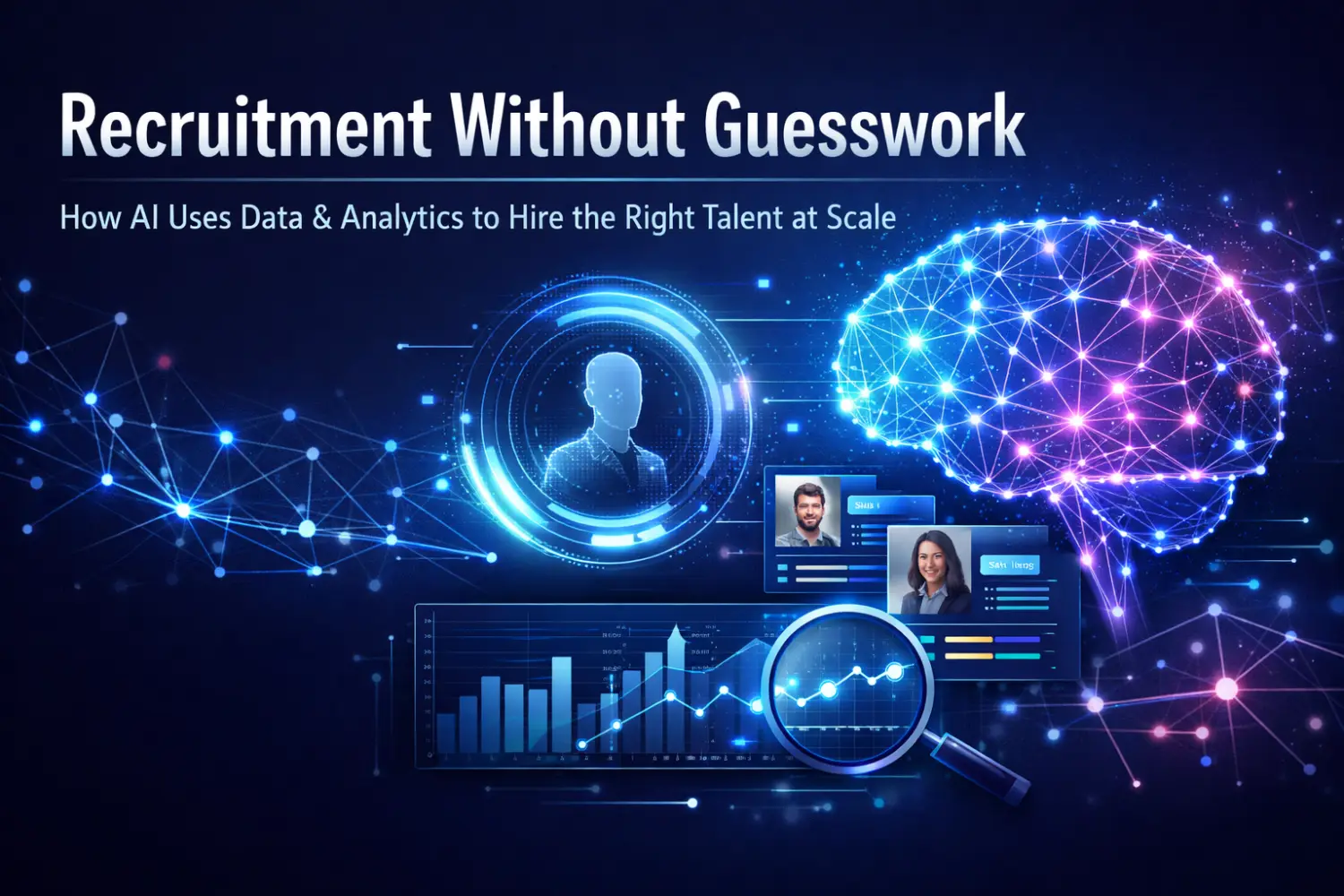
AI systems provide real-time visibility into:
- Number of applications per role
- Source-wise candidate quality
- Screening-to-interview conversion rates
- Time spent at each hiring stage
HR leaders get clear, actionable insights, not just reports.
2. Predictive Hiring Insights
Using historical data, AI can:
- Predict which candidates are likely to succeed
- Identify roles with high attrition risk
- Forecast hiring timelines
- Suggest optimal hiring strategies
This allows companies to plan hiring proactively, not reactively.
3. Skill Gap & Talent Pool Analysis
When thousands of resumes are processed, AI can:
- Identify common skill gaps
- Highlight emerging skill trends
- Build future-ready talent pools
This helps enterprises align hiring with long-term business goals.
4. Bias Reduction Through Data Consistency
Manual hiring often introduces unconscious bias.
AI ensures:
- Uniform screening criteria
- Skill-based evaluation
- Consistent shortlisting logic
Resulting in fairer, more inclusive hiring outcomes—especially important at scale.
Enterprise Scenario
A multinational technology firm hiring across 5 countries used AI analytics to discover:
- 60% of high performers came from just 3 sourcing channels
- Interview delays caused 25% candidate drop-offs
- Certain skills predicted faster on-the-job productivity
Using these insights, they redesigned their hiring strategy—cutting time-to-hire by 35%.
5. Measuring Recruitment ROI with AI
AI enables organizations to measure:
- Cost per hire
- Quality of hire
- Time-to-productivity
- Recruiter efficiency
Recruitment shifts from a cost center to a value-generating function.
Why This Matters for High-Volume Hiring
When candidate data per vacancy is large, AI ensures:
- Better decisions, not just faster decisions
- Data-backed hiring confidence
- Reduced hiring risks
- Stronger workforce outcomes
How True Value Infosoft Helps Enterprises
At True Value Infosoft Private Limited, we build AI-driven recruitment platforms that:
- Capture hiring data end-to-end
- Provide intelligent dashboards
- Enable predictive hiring decisions
- Scale effortlessly with candidate volume
Our goal is simple: help organizations hire smarter, not harder.
Conclusion
The future of recruitment belongs to organizations that trust data over guesswork. AI transforms recruitment into a transparent, measurable, and scalable system—especially when handling massive candidate volumes.
Enterprises that embrace AI-powered recruitment analytics today will build stronger, more agile workforces tomorrow.
FAQs
Data-driven recruitment uses analytics and AI to evaluate candidates based on skills, performance indicators, and hiring outcomes instead of intuition or guesswork.
AI analyzes resumes, assessments, interview data, and past hiring success to predict candidate fit, reducing hiring errors and improving quality-of-hire.
Yes. AI is designed to handle high-volume recruitment by automating screening, ranking candidates, and providing real-time hiring insights at scale.
Analytics track metrics like time-to-hire, candidate conversion rates, and performance outcomes, helping recruiters make informed, data-backed decisions.
When implemented responsibly, AI recruitment systems follow compliance standards and help reduce bias by focusing on objective, job-relevant data.