Introduction: The Hiring Challenge That's Costing You Talent
Hiring the right talent has never been easy. Recruiters spend countless hours scanning resumes, shortlisting candidates, scheduling interviews, and conducting repetitive screening rounds—often only to realize later that the candidate isn't the right fit.
The numbers tell a sobering story. Organizations receive hundreds or thousands of applications per open position. HR teams spend 23 hours on average screening resumes for a single hire. The average time-to-hire stretches to 42 days. And despite all this effort, 46% of new hires fail within the first 18 months.
The traditional hiring process isn't just inefficient—it's fundamentally broken. Manual screening creates bottlenecks, introduces unconscious bias, and causes qualified candidates to slip through the cracks due to human fatigue or inconsistent evaluation criteria.
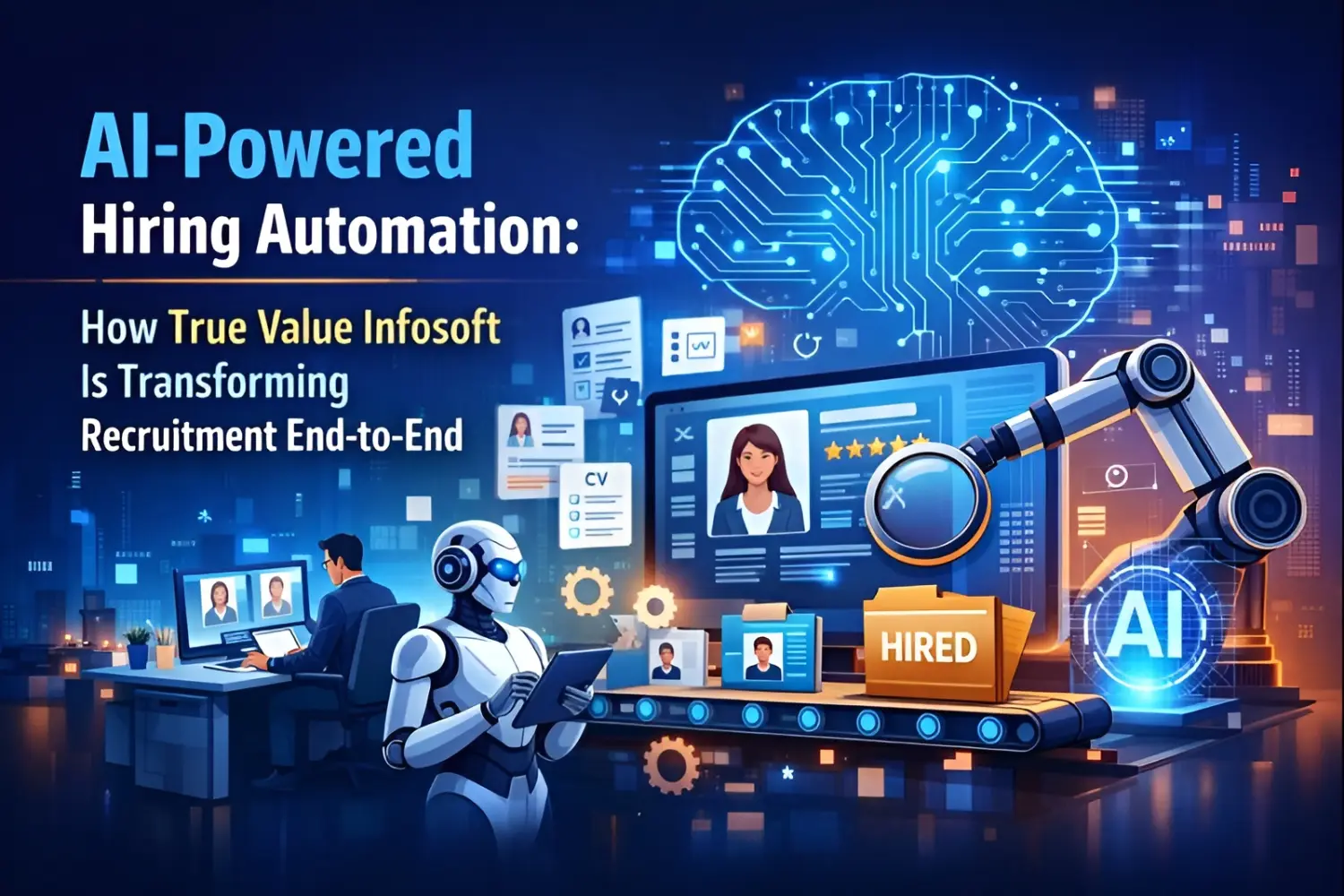
What if the entire hiring process could run automatically, intelligently, and consistently—without compromising quality? At True Value Infosoft, we've built an AI-powered hiring automation solution that does exactly that.
The Problem With Traditional Hiring Processes
Before we discuss AI solutions, let's be honest about what's broken in conventional recruitment. Understanding these pain points reveals why automation isn't just convenient—it's essential for competitive talent acquisition.
The Resume Chaos
Volume Overload: HR teams receive hundreds or thousands of resumes via email, LinkedIn, job boards, and career sites. Managing this influx manually creates immediate chaos—where do you store them? How do you track which ones you've reviewed? Which candidates applied for which positions?
Inconsistent Screening: Manual resume screening varies dramatically based on who's reviewing, when they're reviewing (morning versus late afternoon fatigue), and what mood they're in. The same resume might be rejected by one recruiter and shortlisted by another.
Missed Talent: Good candidates often get overlooked due to human fatigue, unconscious bias, or simple oversight when reviewing the 300th resume of the day. Your ideal candidate might be in the pile, but tired eyes or attention lapses mean they never get considered.
The Scheduling Nightmare
Endless Email Chains: Interview scheduling involves endless back-and-forth emails—checking interviewer availability, proposing times to candidates, rescheduling when conflicts arise, and repeating the process for multiple interview rounds.
Coordination Complexity: Coordinating multiple interviewers, candidates across time zones, and room availability turns scheduling into a logistical nightmare consuming hours of administrative time.
Delays Lose Candidates: Every day of delay increases the risk that top candidates accept offers elsewhere. Slow scheduling directly causes talent loss.
The Inefficiency of Repetitive Screening
Same Questions, Different Candidates: Initial screening interviews ask the same basic questions hundreds of times—"Tell me about your experience with X," "Why are you interested in this role?" These repetitive conversations consume valuable recruiter time without adding proportional value.
Inconsistent Evaluation: Different interviewers emphasize different criteria, ask different follow-ups, and apply subjective judgment inconsistently. This variability undermines fair comparison across candidates.
Interviewer Fatigue: Conducting dozens of similar screening calls leads to interviewer burnout and declining evaluation quality as fatigue sets in.
The Subjectivity Problem
Unconscious Bias: Hiring decisions depend heavily on subjective judgment influenced by unconscious biases around names, schools, previous employers, gaps in employment, and countless other factors unrelated to actual capability.
Gut Feel Over Data: Many hiring decisions rely on "gut feeling" rather than objective evidence, leading to inconsistent standards and missed opportunities to hire capable candidates who don't "feel" right based on superficial factors.
Lack of Standardization: Without consistent evaluation frameworks, comparing candidates becomes challenging and decisions become arbitrary.
The Bottom Line
The result? Delayed hiring, higher costs, missed talent, poor candidate experience, and inconsistent quality of hire. Organizations lose competitive advantage when great candidates go elsewhere while you're still stuck in screening.
Enter AI-Driven Hiring Automation
Our AI hiring software is designed to replace repetitive hiring tasks, not recruiters. This distinction matters—we're not eliminating human judgment from hiring decisions. We're eliminating the tedious, time-consuming, repetitive work that prevents recruiters from focusing on what humans do best: assessing culture fit, building relationships, and making final strategic hiring decisions.
The Intelligent Assistant Model
Think of our system as an intelligent assistant that works 24/7, handling screening, evaluation, communication, and interviews—while HR focuses on decision-making and culture fit.
What AI Handles:
- Resume collection and parsing
- Initial screening and evaluation
- Candidate communication and scheduling
- Structured interview execution
- Data analysis and reporting
What Humans Handle:
- Final hiring decisions
- Culture fit assessment
- Salary negotiations
- Relationship building
- Strategic workforce planning
This division of labor maximizes efficiency while preserving the human elements essential for good hiring outcomes.
How True Value Infosoft's AI Hiring Software Works
Let's break down how the system transforms each stage of the recruitment lifecycle.
Stage 1: Automated Resume Scanning From Email
The hiring process begins when candidates send resumes to your designated hiring email address. From that moment, automation takes over.
Automatic Extraction: Resumes sent to the hiring email are automatically extracted from attachments and email bodies. No manual downloading required.
Intelligent Parsing: Our AI parsing engine extracts structured information from resumes regardless of format—PDFs, Word documents, images, or plain text. The system identifies:
- Contact information
- Work experience and dates
- Educational background
- Skills and certifications
- Projects and achievements
- Keywords and technical competencies
Structured Candidate Profiles: Each resume gets converted into a standardized candidate profile stored in the system. No more Excel sheets, no more folders full of random PDFs, no more "I can't find that candidate's resume."
Automatic Categorization: Candidates are automatically categorized based on job roles, experience levels, and requirements. Applications for "Senior Software Engineer" go to one pipeline, "Marketing Manager" to another.
The Result: Complete elimination of manual resume collection chaos. Every application gets captured, parsed, and organized automatically from the moment it arrives.
Stage 2: AI Resume Evaluation & Candidate Rating
Once parsed, every resume undergoes intelligent evaluation using machine learning models trained on successful hires and role requirements.
Multi-Dimensional Analysis: The system analyzes each candidate across multiple dimensions:
Skills Relevance: Does the candidate possess the technical skills, tools, and technologies required for the role? The AI identifies not just keyword matches but understands skill relationships—for example, that React experience implies JavaScript knowledge.
Experience Alignment: Does the candidate's work history align with the role's requirements? The system evaluates:
- Years of relevant experience
- Progression and growth trajectory
- Company types and sizes
- Industry experience
- Role responsibilities
Job Description Matching: How well does the candidate's background match the specific job description? The AI performs semantic matching beyond simple keyword counting, understanding that "managed a team of 5 engineers" relates to leadership requirements even without the word "leadership."
Role-Specific Indicators: The system identifies role-specific signals of quality—for software engineers, open-source contributions and technical blog posts; for sales roles, quota achievement and deal sizes; for marketing, campaign results and growth metrics.
AI-Generated Suitability Score: Every candidate receives a clear, numerical suitability score (typically 0-100) indicating their match quality. This score reflects:
- Overall qualification level
- Specific strengths and gaps
- Likelihood of success in the role
- Comparative ranking versus other applicants
Transparent Reasoning: The system provides explainable scoring—showing exactly which factors contributed to each candidate's rating. This transparency enables HR teams to understand and trust AI recommendations.
The Result: Instant identification of top talent without reading hundreds of resumes. Recruiters can immediately focus attention on the highest-potential candidates rather than starting from scratch with every application.
Stage 3: Intelligent Screening Questions
For candidates meeting minimum qualification thresholds, the system automatically sends custom screening questions via email or through a candidate portal.
Dynamic Question Generation: Questions are tailored to each candidate's background and the specific role:
Role-Specific Technical Questions: For technical positions, candidates receive questions testing actual knowledge—coding challenges, system design scenarios, technical troubleshooting problems, or domain-specific concepts.
Scenario-Based Questions: Candidates face realistic workplace scenarios requiring them to explain how they'd approach specific challenges relevant to the role.
Behavioral and Situational Prompts: Questions probe work style, collaboration approach, problem-solving methodology, and handling of common workplace situations.
Experience Deep-Dives: Follow-up questions about specific experiences mentioned in resumes—"You mentioned leading a migration to microservices. What challenges did you encounter and how did you address them?"
AI-Powered Response Analysis: When candidates submit answers, the system analyzes responses for:
Accuracy: Do answers demonstrate correct understanding of concepts and best practices?
Clarity: Are explanations well-structured, coherent, and easy to follow?
Depth of Understanding: Do responses show surface-level familiarity or genuine expertise?
Relevance: Do answers directly address the questions asked, or do they deflect and avoid specifics?
Red Flags: The system identifies concerning patterns—overly generic answers, copied content from online sources, contradictions with resume claims, or evasive responses.
Automatic Scoring: Responses receive scores indicating quality, with detailed feedback highlighting strengths and weaknesses for HR review.
The Result: Objective, consistent evaluation of candidate knowledge and communication skills before investing time in live interviews. Weak candidates get filtered out automatically, while strong candidates advance with detailed insights for interviewers.
Stage 4: Automated Interview Scheduling
For candidates who excel in screening questions, the system handles scheduling automatically—eliminating the time-consuming coordination that typically delays hiring.
Availability Intelligence: The system maintains updated availability for all interviewers, integrating with calendar systems (Google Calendar, Outlook, etc.) to understand when people are actually free.
Conflict-Free Scheduling: When a candidate qualifies for interview, the system:
- Identifies available time slots matching both candidate and interviewer schedules
- Accounts for time zones automatically
- Reserves conference rooms or generates video meeting links
- Avoids back-to-back interviews allowing buffer time
Automatic Invitations: Both candidates and interviewers receive calendar invitations with:
- Interview time and duration
- Video conference or location details
- Candidate background and resume
- Interview focus areas and suggested questions
- Preparation materials
Smart Reminders: The system sends automatic reminders:
- 24 hours before interview
- 1 hour before interview
- Immediate notification of any changes
Rescheduling Logic: If conflicts arise, the system handles rescheduling automatically—proposing alternative times, updating calendars, and notifying all parties.
The Result: Interview scheduling that would take hours of coordination happens in seconds. No follow-ups, no calendar conflicts, no delays. Candidates experience professional, efficient scheduling regardless of company size or HR bandwidth.
Stage 5: AI-Conducted Interviews
Yes—the interview itself can be conducted by AI. This is where our system becomes truly transformative, enabling scalable, consistent, and fair interviews especially valuable for high-volume hiring.
Structured Interview Execution: The AI conducts interviews following best-practice structured interview methodologies:
Prepared Question Set: Each interview follows a standardized question set ensuring every candidate for a role gets evaluated on the same criteria.
Dynamic Follow-Ups: Unlike rigid scripts, the AI adapts follow-up questions dynamically based on candidate responses:
- Probes deeper into interesting or unclear answers
- Asks for specific examples when responses are too abstract
- Tests claimed expertise with technical follow-ups
- Explores red flags or inconsistencies
Natural Conversation Flow: The interview feels conversational rather than robotic, with the AI acknowledging responses, providing context for questions, and maintaining appropriate pacing.
Multi-Modal Evaluation: For video interviews, the system analyzes:
- Verbal Content: What the candidate says—quality of answers, depth of knowledge, clarity of communication
- Communication Skills: How effectively they explain complex concepts, structure responses, and adapt to questions
- Confidence and Presence: Body language, eye contact (through video analysis), vocal tone, and apparent confidence level
Real-Time Analysis: As the interview progresses, the AI continuously evaluates responses, identifying strengths, weaknesses, and areas requiring deeper exploration.
Comprehensive Interview Summaries: After completion, the system generates detailed reports for HR teams including:
- Transcript of the interview
- Scores across evaluated dimensions
- Key strengths and concerns identified
- Specific response highlights (both positive and negative)
- Comparison to other candidates
- Recommendation on advancement
The Result: Fair, consistent, and scalable interviews. Every candidate gets evaluated against the same standards by an interviewer that never gets tired, biased, or inconsistent. High-volume hiring becomes manageable without sacrificing interview quality.
Key Benefits of AI Hiring Automation
Implementing AI-powered hiring automation delivers measurable improvements across every metric that matters for recruitment.
Faster Hiring Cycles
Traditional Timeline: Resume screening (1-2 weeks), initial scheduling (3-5 days), screening interviews (1-2 weeks), evaluation (3-5 days), final interview scheduling (3-5 days). Total: 4-6 weeks minimum.
With AI Automation: Resume screening (hours), automatic scheduling (seconds), AI screening (1-2 days), evaluation (instant), final interview scheduling (seconds). Total: 7-10 days.
Impact: Reduce time-to-hire from weeks to days. Top candidates don't get lost to competitors while you're still scheduling. Fast hiring becomes competitive advantage.
Better Candidate Quality
Data-Driven Evaluation: Every decision backed by objective analysis rather than gut feeling or subjective impression.
Consistent Standards: Every candidate evaluated against the same criteria using the same methodology. No variation based on interviewer mood, energy level, or unconscious biases.
Merit-Based Shortlisting: The best candidates rise to the top based on actual qualifications and demonstrated capabilities, not superficial factors like where they went to school or which companies are on their resume.
Comprehensive Assessment: AI interviews evaluate multiple dimensions simultaneously—technical knowledge, communication skills, problem-solving approach, and relevant experience—providing richer data for hiring decisions.
Impact: Hire people who actually succeed in the role rather than people who interview well or look good on paper. Reduce early turnover, improve team performance, and build stronger organizations.
Reduced Hiring Costs
Less Manual Effort: Eliminate hundreds of hours of resume screening, email coordination, and repetitive screening interviews. HR teams redirect time toward high-value activities.
Fewer HR Hours Required: Automation allows smaller HR teams to handle larger hiring volumes without proportional headcount increases.
Higher Efficiency: The same recruiter managing 10-15 open positions manually can handle 50-100 with AI automation—5x productivity improvement.
Reduced Bad Hires: Better evaluation reduces costly hiring mistakes. Replacing a bad hire costs 30% of annual salary on average—eliminating even a few bad hires per year saves tens of thousands of dollars.
Impact: Significantly lower cost-per-hire and higher ROI on recruiting investments. Scale hiring without scaling recruiting team proportionally.
Reduced Bias
Blind Initial Screening: AI evaluates resumes based on qualifications without seeing names, photos, schools, or other factors that trigger unconscious human biases.
Standardized Evaluation: Every candidate assessed against identical criteria. No variation based on interviewer preferences, assumptions, or prejudices.
Objective Scoring: Numerical ratings based on demonstrated capabilities rather than subjective "likeability" or "cultural fit" judgments that often mask bias.
Audit Trail: Complete transparency into evaluation criteria and scoring methodology. Organizations can verify fairness and identify any problematic patterns.
Impact: More diverse, inclusive hiring leading to stronger teams and better business outcomes. Reduced legal risk from discriminatory hiring practices. Improved employer brand reputation.
Scalable Recruitment
Volume Flexibility: Handle 10 or 10,000 candidates without increasing HR workload proportionally. The system scales effortlessly as hiring needs grow.
Geographic Expansion: Hire across multiple locations, time zones, and countries without establishing local recruiting teams everywhere.
Seasonal Hiring: Manage dramatic hiring spikes (holiday season, project ramp-ups, growth phases) without temporary recruiting staff.
Multiple Roles: Run parallel hiring processes for dozens of different positions simultaneously without overwhelming coordination complexity.
Impact: Growth unimpeded by recruiting capacity constraints. Enter new markets quickly. Handle explosive growth without hiring bottlenecks.
Real-World Impact: What Organizations Experience
Beyond theoretical benefits, organizations implementing our AI hiring automation see concrete, measurable improvements:
Time Savings:
- 80% reduction in time spent on resume screening
- 90% reduction in interview scheduling time
- 70% reduction in initial screening interview hours
- 50% faster overall time-to-hire
Quality Improvements:
- 40% increase in candidate quality scores
- 35% reduction in early turnover (departures within first year)
- 60% improvement in hiring manager satisfaction with candidates
- 25% increase in offer acceptance rates (due to faster, more professional process)
Cost Reductions:
- 65% lower cost-per-hire
- 5x improvement in recruiter productivity (positions managed per recruiter)
- 50% reduction in bad hire costs
- ROI typically achieved within 4-6 months of implementation
Diversity and Fairness:
- 45% increase in candidate diversity advancing to final rounds
- 30% reduction in demographic disparities in hiring outcomes
- 100% consistency in evaluation criteria application
- Complete audit trail enabling fairness verification
Implementation and Integration
Deploying AI hiring automation integrates seamlessly with existing recruitment workflows and systems.
Quick Setup Process
Email Configuration: Designate hiring email addresses that automatically feed into the system. Typically takes 15 minutes.
Job Role Setup: Define roles, requirements, and evaluation criteria. Our templates accelerate this for common positions.
Interviewer Integration: Connect calendars and set availability preferences. One-time setup per interviewer.
Customization: Tailor screening questions, interview structures, and evaluation rubrics to your organization's specific needs.
Testing and Validation: Run pilot hiring processes, refine configurations based on results, and validate quality before full deployment.
Timeline: Most organizations are fully operational within 2-3 weeks from decision to deployment.
Integration with Existing Systems
Applicant Tracking Systems (ATS): Bi-directional integration with major ATS platforms—candidates flow automatically, status updates sync in real-time.
Calendar Systems: Native integration with Google Calendar, Outlook, and other scheduling tools.
Communication Platforms: Connect with email systems, Slack, Teams, or other communication tools for notifications and updates.
HRIS Systems: Pass hired candidates automatically to onboarding systems with complete hiring data.
Analytics Platforms: Export hiring data to business intelligence tools for comprehensive workforce analytics.
Ongoing Support and Optimization
Performance Monitoring: Track key metrics—time-to-hire, candidate quality, process efficiency, user satisfaction.
Continuous Improvement: Regular model updates incorporating your hiring outcomes to improve evaluation accuracy over time.
Support and Training: Ongoing support ensuring your team maximizes value from the system.
Custom Development: For unique requirements, we provide custom development ensuring the system perfectly fits your needs.
From Automation to Transformation: Why True Value Infosoft
Building AI hiring automation software is one thing. Delivering transformation in recruitment outcomes is another. True Value Infosoft combines technical excellence with deep recruitment domain expertise.
Why Organizations Choose Us
Proven Technology: Our AI models are trained on millions of resumes and successful hires, delivering accurate evaluation from day one.
Customization Expertise: Every organization hires differently. We tailor the system to your specific roles, culture, and requirements rather than forcing you into generic templates.
Fairness and Compliance: Our systems are designed for fairness, with built-in bias detection and mitigation. We help you hire compliantly while improving diversity.
Human-Centered Design: We augment recruiters, not replace them. Our UX ensures HR teams love using the system rather than fighting it.
Measurable ROI: We track impact meticulously, demonstrating clear return on investment through time savings, cost reductions, and quality improvements.
End-to-End Support: From initial setup through ongoing optimization, we partner with you for long-term success.
Our Commitment
At True Value Infosoft, we're not just selling software—we're transforming how organizations build great teams. We believe the best candidate should get hired, regardless of what school they attended, who they know, or how they interview when tired or nervous.
Our AI hiring automation makes that vision reality by bringing objectivity, consistency, and intelligence to every stage of recruitment.
Ready to Transform Your Hiring Process?
Traditional hiring is broken—manual screening, scheduling chaos, repetitive interviews, unconscious bias, and delayed decisions that lose top talent. Organizations maintaining these outdated processes face systematic disadvantage against competitors who've embraced intelligent automation.
The question isn't whether to automate hiring—it's whether you'll lead or lag as recruitment transforms. Early adopters gain immediate advantage: faster hiring, better candidates, lower costs, and competitive edge in talent acquisition.
True Value Infosoft's AI-powered hiring automation delivers complete recruitment transformation—from resume scanning through interview execution. Our system works 24/7, handling repetitive tasks intelligently and consistently while your HR team focuses on what humans do best: building relationships and making strategic decisions.
Let's discuss how AI hiring automation can transform your recruitment outcomes. Connect with True Value Infosoft today to schedule a demo and discover how our solution delivers faster hiring, better candidates, and measurable ROI within months of deployment.
The future of hiring is intelligent, automated, and fair. The question is whether you'll lead this transformation or watch competitors pull ahead while you're still manually screening resumes.
FAQs
AI screening matches or exceeds human accuracy while being far more consistent. Our models achieve 90%+ accuracy in identifying qualified candidates versus 60-70% for human screening (which varies dramatically based on fatigue, attention, and individual judgment). Critically, AI applies identical standards to every candidate—humans unconsciously vary criteria throughout the day. AI finds strong candidates that humans miss while filtering weak candidates humans might pass due to fatigue or bias.
For AI-conducted interviews, we recommend transparency—candidates are informed they're interacting with AI. However, the interview experience feels natural and conversational, not robotic. Candidates appreciate the consistency, fairness, and convenience (scheduling flexibility, immediate feedback availability) that AI interviews provide. Our data shows candidate satisfaction with AI interviews is comparable to or higher than human screening interviews.
No—it eliminates tedious tasks, not jobs. Recruiters freed from resume screening and repetitive screening interviews redirect time to high-value activities: building talent pipelines, developing employer brand, counseling hiring managers, negotiating offers, and ensuring excellent candidate experience. Organizations typically maintain recruiting team sizes while dramatically increasing hiring capacity and quality. AI makes recruiters more effective and strategic, not obsolete.
We employ multiple bias mitigation strategies: training data balanced across demographics, evaluation criteria focused solely on job-relevant factors, blind screening removing demographic information from initial evaluation, regular bias audits analyzing outcomes across protected groups, and transparent scoring showing exactly why candidates received specific ratings. Our systems undergo continuous monitoring ensuring fair outcomes and can be audited to verify compliance with employment law.
Most organizations achieve positive ROI within 4-6 months through time savings, cost reductions, and improved quality of hire. Immediate benefits include 80% reduction in resume screening time and 90% reduction in scheduling time. Quality improvements (better candidates, lower turnover) accumulate over subsequent months. Typical first-year ROI ranges from 300-500% when accounting for recruiter productivity improvements, reduced bad hire costs, and competitive advantage from faster hiring. Results begin the day system goes live.