Introduction: Beyond the Hype to Real Clarity
Artificial intelligence dominates every conversation today. Every company faces pressure to become an "AI company," and headlines tout revolutionary AI transformations across industries. Amidst this noise, many business leaders feel confused. They know they must do something, but understanding where to actually start and what to expect remains elusive.
The truth: Successfully implementing AI is far more complex—and often counterintuitive—than headlines suggest. It's not just about purchasing new technology; it's about strategy, operations, and people. This article presents the most important and surprising lessons from a deep conversation with AI expert Matt Fitzpatrick, CEO of Invisible Technologies, providing clarity beyond the hype.
For business leaders navigating AI adoption, these truths challenge popular narratives and provide actionable frameworks for successful implementation. Understanding these realities determines whether your AI initiatives deliver transformative value or become expensive disappointments.
Truth 1: AI's Impact Won't Be Equal Across All Industries
A common assumption holds that AI will revolutionize every industry equally. Reality tells a different story. Expert analysis reveals AI's impact will vary dramatically across sectors, challenging the popular narrative that AI represents a universal disruptive force.
The Differential Impact Pattern
According to Matt Fitzpatrick, some sectors will experience fundamental structural transformation while others see marginal enhancement to existing operations.
Industries Facing Fundamental Transformation:
Media and Content: Knowledge work involving large-scale document production—journalism, publishing, creative content—faces wholesale restructuring as AI generates, edits, and optimizes content at scales impossible for human teams.
Legal Services: Document review, contract analysis, legal research, and discovery work increasingly automated. Junior attorney and paralegal functions particularly vulnerable as AI handles routine legal tasks at fraction of traditional costs.
Business Process Outsourcing: The entire BPO industry built on labor arbitrage faces existential threat as AI handles customer service, data processing, transaction management, and administrative work more efficiently than offshore teams.
Industries Experiencing Enhancement, Not Revolution:
Oil and Gas: Core operations—exploration, extraction, refining, distribution—remain fundamentally physical processes. AI optimizes operations but doesn't restructure the industry.
Real Estate: Buying an apartment building today involves the same fundamental considerations as five years ago. AI tools assist analysis and operations but don't change core business model.
Manufacturing: While AI improves quality control, predictive maintenance, and supply chain optimization, physical production processes remain largely unchanged.
The Strategic Question
Therefore, the crucial question for any business isn't whether AI will change everything, but rather: "Which parts of your business can actually transform with AI?"
Framework for Assessment:
Identify Knowledge-Intensive Processes: Which operations involve primarily information processing, pattern recognition, document generation, or data analysis? These face highest transformation potential.
Evaluate Physical vs. Digital: Physical operations resist wholesale transformation; digital operations face more dramatic change. Where does your value creation happen?
Assess Decision Complexity: Routine, rule-based decisions automate easily. Complex judgment requiring contextual understanding resists full automation but benefits from AI augmentation.
Consider Regulatory Constraints: Heavily regulated industries face slower transformation regardless of technical feasibility. Healthcare, finance, and legal services navigate compliance requirements limiting rapid AI adoption.
The Resource Allocation Imperative
Focus energy on areas where AI adds maximum value rather than pursuing AI for its own sake. Organizations spreading AI efforts thinly across all functions dilute resources and deliver mediocre results everywhere. Those concentrating on high-impact areas achieve transformative outcomes in targeted domains.
Practical Approach:
- Map your value chain identifying information-intensive vs. physical operations
- Assess transformation potential for each component
- Prioritize AI investment where impact potential is highest
- Accept that some areas won't benefit significantly from AI—and that's fine
Truth 2: Forget Full Automation—'Human in the Loop' Is Your Real Strength
One of the biggest misconceptions when implementing AI: the goal should be 100% automation. This is backwards thinking. In many cases, full automation isn't just unrealistic—it's actively harmful.
The Klarna Cautionary Tale
Klarna's recent, widely publicized story provides a perfect example. The company announced they were moving toward a fully "agentic contact center." Their claim: in the first month alone, their AI did the work of 700 full-time agents, handled 2.3 million calls, and would save the company an estimated $40 million annually.
A few months later, they rolled back this initiative and resumed using human agents.
What Went Wrong?: Fitzpatrick's hypothesis: you almost always want a mix of humans and agents, especially for complex issues or situations where no prior data exists.
The Reality:
- AI excels at routine, repetitive inquiries with clear resolution paths
- Human agents handle complex problems requiring judgment, empathy, and creativity
- Edge cases without precedent require human problem-solving
- Customer satisfaction often depends on human connection for difficult situations
- Brand reputation suffers when automation fails spectacularly on visible customer interactions
The Core Principle
Fitzpatrick articulates this powerfully: "You never want to move toward making everything agentic. In almost every industry, in almost every topic, you want to keep humans in the loop."
Why Human-in-the-Loop Works:
Judgment on Exceptions: AI handles 80-90% of routine cases efficiently. Humans focus on the 10-20% requiring nuanced judgment, ensuring quality on challenging situations.
Learning Feedback Loop: Human oversight of AI outputs provides training signal improving system performance over time. Fully automated systems lack this correction mechanism.
Customer Trust: Knowing humans remain available for complex issues maintains customer confidence. Purely automated systems create anxiety about getting trapped in AI loops without human escalation.
Adaptability: Business conditions change—new products, policies, market conditions. Humans adapt quickly; AI systems require retraining. Human oversight bridges adaptation gaps.
Risk Mitigation: When AI makes errors (it will), human oversight catches problems before they cascade into major failures or reputational damage.
Implementation Framework
Design for Hybrid Operations:
- Identify tasks AI handles completely autonomously (simple, routine, high-volume)
- Define tasks requiring human judgment (complex, novel, high-stakes)
- Create smooth handoff mechanisms between AI and humans
- Establish clear escalation criteria triggering human intervention
- Train humans to work effectively with AI rather than instead of AI
Measure Hybrid Performance: Don't just measure automation rate. Measure:
- Overall outcome quality (customer satisfaction, accuracy, resolution time)
- Cost efficiency (total cost per transaction, not just labor)
- Human satisfaction (are people doing more meaningful work?)
- System resilience (how well does the system handle edge cases?)
Truth 3: The Biggest Mistakes? Ignoring Data Quality and Organizational Structure
Companies attempting AI implementation commonly make mistakes that undermine success. The two biggest: ignoring data quality and adopting wrong organizational structure.
Mistake #1: Data Quality Assumptions
The Misconception: "We need perfect data across the entire company before starting AI."
The Reality: You need clean, focused data for the specific use case you're addressing. This doesn't mean your company's entire data infrastructure must be pristine.
What Matters:
Use-Case Specific Quality: For the particular problem you're solving, data must be accurate, complete, and accessible. If implementing AI for customer service, your support ticket data needs to be clean—your manufacturing data quality is irrelevant.
Unstructured Data Value: Much valuable data is unstructured—images, videos, text, conversations, documents. Don't assume only structured database information matters. Often the richest insights come from unstructured sources.
Incremental Improvement: Start with available data for initial AI implementation. As you learn what matters, improve data collection and quality incrementally rather than delaying implementation until perfect data exists.
Practical Steps:
- Identify specific use case for AI implementation
- Assess data quality for that specific application
- Clean and prepare only the data needed for this use case
- Launch AI system with imperfect but adequate data
- Improve data quality iteratively based on system performance
Mistake #2: Wrong Organizational Structure
This may be the most critical mistake—and the most commonly overlooked.
The Typical Failure Pattern: AI initiatives get placed within IT departments as "science projects." When this happens, they become disconnected from actual business outcomes and fail.
Why This Fails:
IT Optimization Mindset: Technology teams optimize for technical elegance, not business results. They build sophisticated systems that don't solve real problems.
Disconnection from Operations: IT doesn't deeply understand operational constraints, customer needs, or business priorities. Solutions built without this understanding miss the mark.
Wrong Success Metrics: Technology teams measure technical metrics (model accuracy, processing speed) rather than business outcomes (revenue impact, cost reduction, customer satisfaction).
Lack of Operational Urgency: IT projects operate on technology timelines. Business operations require urgency and rapid iteration based on real-world feedback.
Fitzpatrick's Clear Advice
"Don't put this in your technology organization. Take your best operator, your best ops person, give them an operational KPI and track that."
The Right Structure:
Operator Leadership: AI initiatives should be led by operators who understand the business problem deeply and measure success in business outcomes, not technical metrics.
Operational KPIs: Track business metrics—customer satisfaction, cost per transaction, revenue per employee, error rates—not just AI performance metrics.
Cross-Functional Teams: Combine operational expertise, domain knowledge, and technical capability. But operators lead, not technologists.
Business Case Accountability: The leader should be accountable for ROI, not just for delivering a working system.
Iterative Deployment: Operators understand that imperfect solutions delivering business value beat perfect solutions never deployed.
Implementation Approach:
- Identify business problem with clear financial impact
- Assign to your best operator in that domain
- Give them budget, authority, and technical resources
- Define operational KPI measuring business outcome
- Iterate rapidly based on real-world performance
- Scale when proven rather than building comprehensive systems upfront
Truth 4: AI Success Isn't General Intelligence—It's Hyper-Specific Benchmarks
The way AI performance gets measured is rapidly changing. Until now, focus centered on "large public benchmarks"—tests like coding capabilities or general reasoning. These are useful for tracking general model improvement but don't address specific business needs.
The Future Is Custom Evaluation
The future belongs to "custom evaluations on highly specific topics." Think of it this way: A general knowledge exam cannot tell you whether someone can perform a specialist task with precision.
Example: For an insurance company, it matters far more whether AI can process claims like their expert human adjuster than whether it can write poetry or solve abstract logic puzzles.
Why General Benchmarks Fail:
Domain Mismatch: Public benchmarks test general capabilities. Your business requires specific domain expertise, terminology, and processes that general tests don't evaluate.
Risk Profile: General benchmarks optimize for average performance. Your business cares about performance on your specific data distribution, which may differ significantly from test sets.
Regulatory Requirements: Compliance demands may require capabilities not measured by public benchmarks—explainability, bias metrics, audit trails.
Integration Context: Performance in isolation differs from performance integrated with your systems, data, and workflows.
Building Custom Benchmarks
This means most businesses must develop their own custom benchmarks measuring AI performance against their expert humans.
Framework for Custom Evaluation:
Capture Expert Performance: Document how your best human performers handle typical and edge cases. What accuracy do they achieve? How long does it take? What's their error rate?
Create Representative Test Sets: Compile actual examples from your operations covering routine cases, complex situations, and edge cases in proportions matching real-world distribution.
Define Success Criteria: What accuracy is acceptable? What types of errors are tolerable versus unacceptable? How does performance need to compare to human experts?
Measure Continuously: Benchmark AI performance regularly as systems improve and as your business evolves. Static benchmarks become outdated quickly.
Validate on Production Data: Test performance doesn't always match production reality. Validate custom benchmarks against actual deployment outcomes.
The Strategic Opportunity
This shift creates enormous opportunity for industry experts. Whoever can create a credible benchmark for their domain and establish it as standard becomes a leader in that space.
The Benchmark Advantage:
Industry Standard Setting: The organization defining how AI performance gets measured in your industry shapes adoption criteria across the sector.
Competitive Differentiation: Superior performance on industry-standard benchmarks becomes powerful competitive signal.
Partnership Attraction: AI vendors prioritize optimizing for established benchmarks. Creating your industry's benchmark makes you attractive partner for leading AI companies.
Thought Leadership: Benchmark creation positions you as authority in your domain's AI application.
Practical Approach:
- Identify core competencies where AI could augment or replace humans
- Document expert human performance comprehensively
- Create evaluation framework measuring AI against this standard
- Publish benchmark methodology transparently
- Encourage industry adoption through open access
- Iterate benchmark as AI capabilities and business needs evolve
The Path Forward: Strategy Over Technology
Succeeding in AI's world isn't just about adopting new technology. As we've seen, success depends on focused strategy, operational discipline, and most importantly, leveraging human expertise.
The Real AI Strategy
Selective Transformation: Focus on areas where AI creates genuine value, not spreading efforts thinly across all functions.
Hybrid Operations: Design for human-AI collaboration rather than full automation, capturing benefits of both.
Operational Leadership: Place AI initiatives under operators measuring business outcomes, not IT measuring technical metrics.
Custom Evaluation: Develop benchmarks measuring what matters for your specific business rather than relying on general capability assessments.
It's Evolution, Not Revolution
AI represents evolution more than revolution—intelligently recognizing where to automate, where to augment human capabilities, and how to measure success.
The real question for the next decade isn't "How will AI replace our jobs?" but rather: "How will we redesign our work to collaborate with AI in ways we can't yet imagine?"
This reframing shifts perspective from defensive (protecting jobs) to proactive (creating new value through human-AI combination). Organizations embracing this mindset position themselves to thrive rather than just survive AI transformation.
From Understanding to Implementation: How True Value Infosoft Delivers AI Success
Understanding these truths intellectually is valuable; implementing AI successfully based on them requires expertise, strategy, and execution discipline.
Our AI Implementation Services
At True Value Infosoft (TVI), we help organizations navigate AI adoption through services grounded in the truths outlined above:
AI Impact Assessment: We analyze your specific business identifying which areas truly benefit from AI versus those where investment won't deliver meaningful returns. This focused approach prevents wasted resources on low-impact initiatives.
Hybrid System Design: We architect human-AI collaboration optimally—determining which tasks AI handles autonomously, which require human oversight, and how to create smooth handoffs between automated and human-operated workflows.
Operational AI Leadership: We help structure AI initiatives under operational leadership with clear business KPIs rather than technology-focused metrics. Our approach ensures AI delivers business outcomes, not just technical achievements.
Custom Benchmark Development: We work with your domain experts creating evaluation frameworks measuring AI performance against your specific requirements rather than generic capabilities.
Data Strategy for AI: We assess data readiness for specific use cases, helping you clean and prepare the focused data sets needed for successful implementation rather than pursuing perfect enterprise-wide data quality.
Strategic Consulting Services
Beyond implementation, we provide strategic guidance:
- Industry-specific impact analysis: Understanding how AI transforms your specific sector
- Use case prioritization: Identifying highest-value AI applications for your business
- Organizational design: Structuring teams and governance for AI success
- Change management: Preparing your organization for human-AI collaboration
- Benchmark strategy: Developing evaluation frameworks establishing industry standards
Our Implementation Approach
Phase 1 - Strategic Assessment (2-4 weeks):
- Identify high-impact use cases specific to your business
- Assess data readiness for priority applications
- Design organizational structure for operational leadership
- Define business KPIs measuring success
Phase 2 - Focused Pilot (6-12 weeks):
- Implement AI for single high-value use case
- Design hybrid human-AI workflows
- Develop custom benchmarks for evaluation
- Measure business impact, not just technical performance
Phase 3 - Iterative Scaling (3-6 months):
- Refine based on pilot learnings
- Expand to additional use cases
- Build internal capability for sustained success
- Establish continuous improvement processes
We don't believe in comprehensive AI transformations launched simultaneously across organizations. We believe in focused, operator-led, iteratively scaled implementations delivering measurable business value quickly.
Ready to Implement AI That Actually Works?
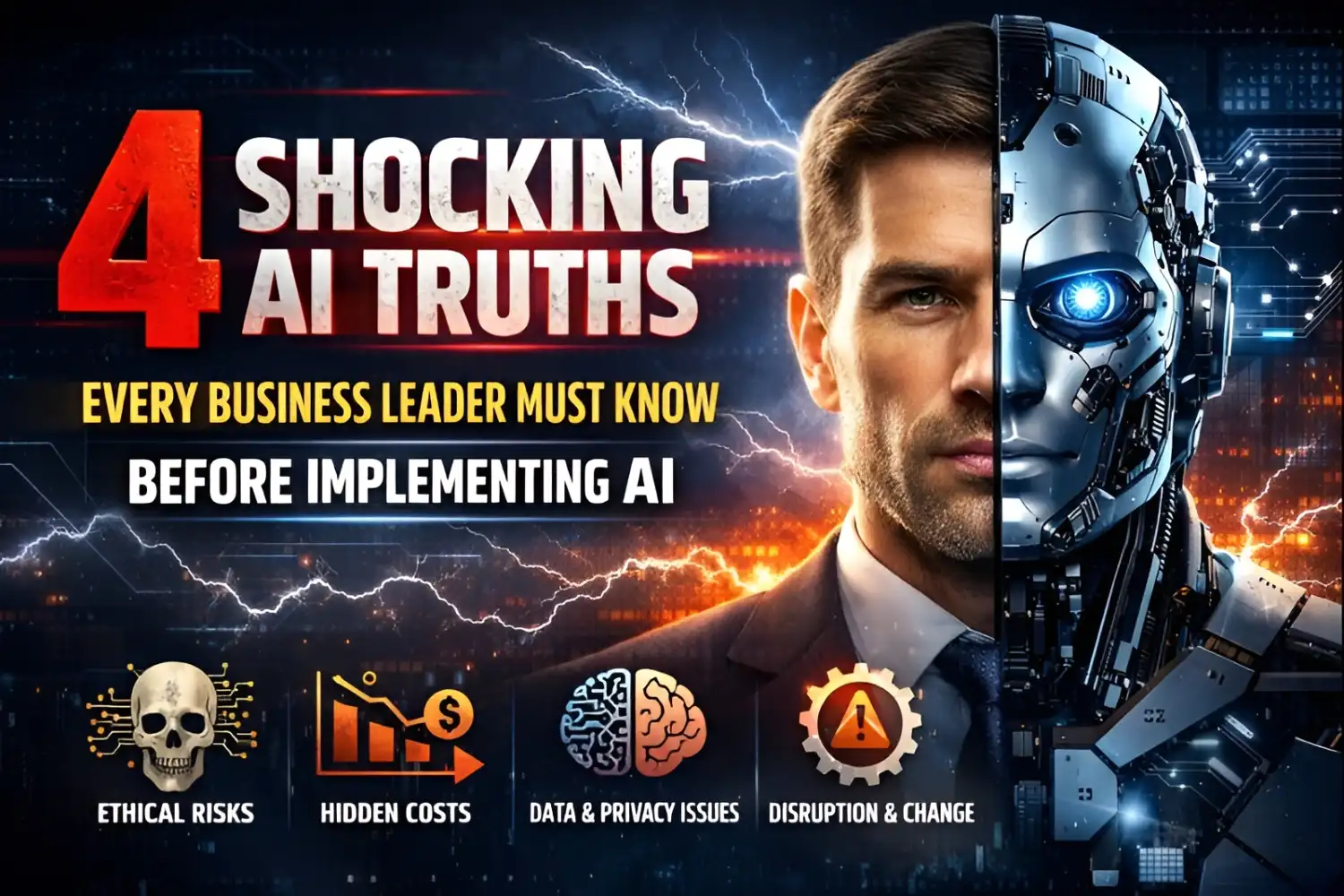
The four truths outlined challenge popular AI narratives: Impact varies by industry. Full automation is wrong goal. Data quality and organizational structure matter more than technology. Custom benchmarks matter more than general capabilities.
For business leaders, these insights provide clarity cutting through hype. Successful AI adoption isn't about chasing every AI trend or automating everything possible. It's about strategic focus, hybrid human-AI design, operational leadership, and measuring what matters for your specific business.
The organizations succeeding with AI aren't those with biggest budgets or most advanced technology. They're those with clearest strategy, best execution discipline, and deepest understanding of where AI creates genuine value versus where it's just expensive distraction.
At True Value Infosoft, we help organizations navigate AI adoption through practical, business-focused implementation grounded in the realities of what actually works rather than what headlines promise.
Let's discuss how your organization can implement AI successfully. Connect with True Value Infosoft today to explore how we can help you develop focused AI strategy, design hybrid operations, and deliver measurable business outcomes rather than just technical achievements.
AI's transformation is real—but it's not what most headlines suggest. The question is whether you'll pursue AI strategically or get swept up in hype leading to expensive failures.
FAQs
Assess each business function along two dimensions: information intensity (how much does this function involve processing information vs. physical operations?) and decision complexity (are decisions routine and rule-based or require nuanced judgment?). High information intensity with routine decisions offers greatest automation potential. Physical operations or highly complex judgment benefit less. Focus AI investment where these factors align favorably rather than pursuing AI everywhere uniformly.
Human-in-the-loop means AI handles routine cases automatically while humans handle exceptions, complex situations, and quality oversight. Practically: AI processes 80-90% of transactions independently, humans receive alerts for edge cases or low-confidence situations requiring judgment, quality sampling ensures AI performance remains acceptable, and smooth escalation mechanisms enable customers to reach humans easily when needed. Measure success on overall outcomes, not automation rate.
IT optimizes for technical excellence rather than business outcomes, lacks deep operational context to recognize what matters versus what's technically interesting, measures success through technical metrics (model accuracy) rather than business impact (revenue, cost savings), and operates on technology timelines rather than business urgency. AI initiatives need operator leadership with operational KPIs, business accountability, and authority to iterate rapidly based on real-world performance—characteristics IT organizations typically lack.
Start by documenting your expert humans' performance: accuracy rates, processing times, error types and frequencies, edge case handling. Create test sets from actual business examples covering typical and difficult cases in realistic proportions. Define acceptable performance thresholds based on business requirements, not perfection. Validate benchmarks against production deployment to ensure test performance predicts real-world outcomes. Update benchmarks as your business evolves and AI capabilities advance.
For focused, single-use-case implementations with operator leadership and adequate data: 2-4 weeks for assessment and planning, 6-12 weeks for pilot deployment and validation, 3-6 months for iterative scaling and refinement. Organizations achieving success follow this focused, iterative approach. Those pursuing comprehensive enterprise-wide AI transformations simultaneously often spend years without delivering measurable business value. Start narrow, prove value quickly, then scale based on validated success—not the reverse.