Introduction
Software development is changing rapidly. Artificial Intelligence (AI) is no longer limited to generating code snippets or helping developers complete repetitive programming tasks. In 2026, AI-powered coding agents are taking on more advanced responsibilities, including reviewing pull requests, identifying bugs, suggesting fixes, running tests, and even approving certain software changes.
Traditionally, software development teams relied on developers and quality assurance engineers to inspect code, identify errors, test functionality, and approve changes before deployment. While this process helps maintain software quality, it can also consume considerable time, particularly in projects with frequent releases and large development teams.
Now, AI coding agents are making these workflows faster and more automated.
The latest developments are particularly interesting. On November 23, 2026, Anthropic announced Claude Ship, introducing AI agents designed to review pull requests, resolve CI failures, handle merge conflicts, and approve eligible changes according to organizational policies.
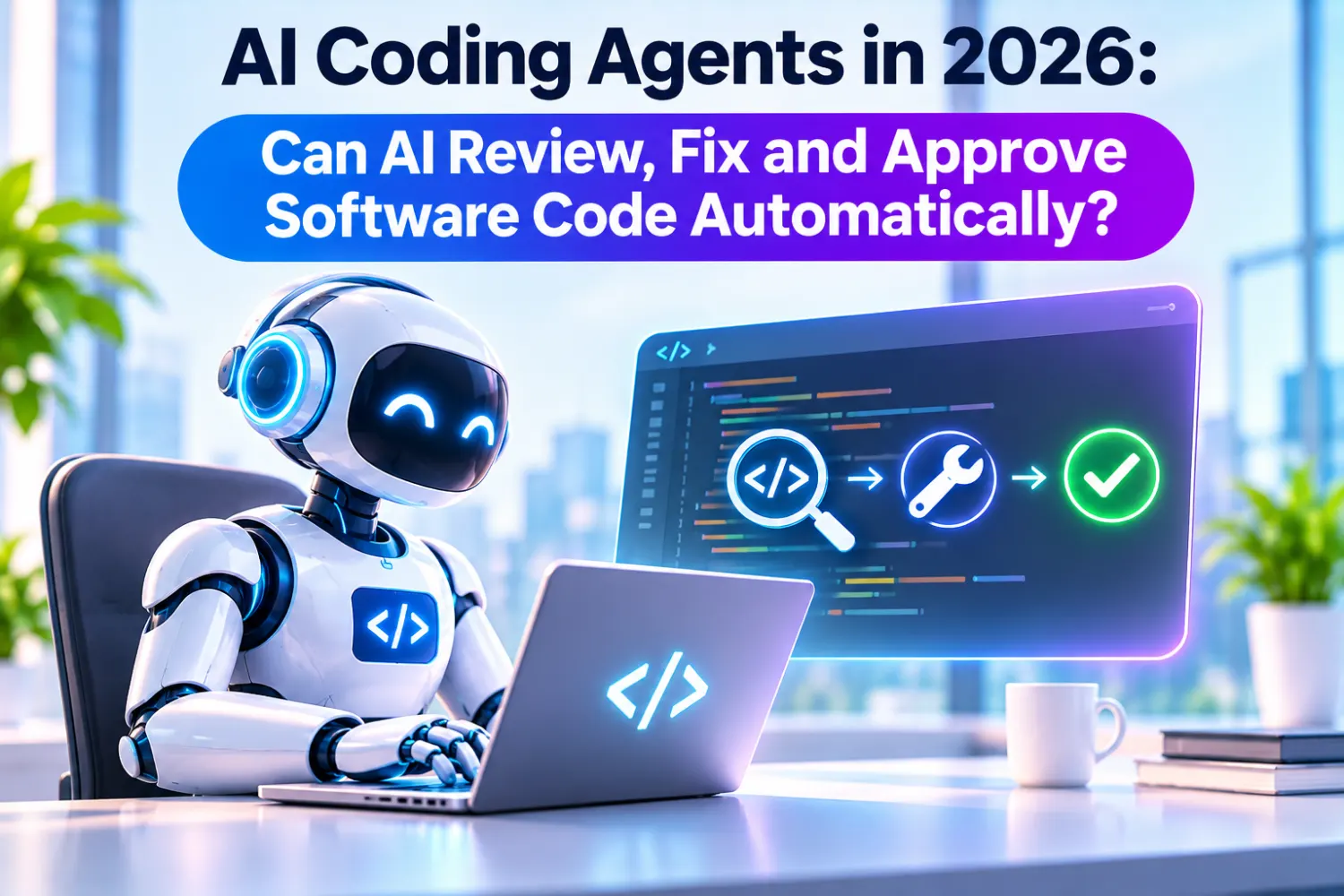
This raises an important question: Can AI coding agents independently manage the software code review and approval process, or will human developers remain essential?
Let's explore how these technologies work, what they can automate, their limitations, and what businesses should expect from AI-powered software development in 2026.
What Are AI Coding Agents?
AI coding agents are intelligent software tools powered by large language models (LLMs) that can understand programming tasks, interact with development environments, modify source code, execute commands, and perform multiple development activities.
Unlike traditional AI coding assistants that primarily suggest code when prompted, autonomous coding agents can work through a sequence of tasks to achieve a defined development goal.
For example, a developer might ask an AI coding agent to:
- Identify bugs in a React application.
- Review a newly submitted pull request.
- Fix errors in Node.js API endpoints.
- Generate and execute unit tests.
- Identify potential security vulnerabilities.
- Resolve failed CI/CD pipeline checks.
- Prepare code changes for human review.
Depending on its permissions and configuration, an AI agent can perform several of these activities without requiring developers to manually complete every step.
AI Coding Assistants vs. AI Coding Agents
Although these terms are often used interchangeably, they have different capabilities.
| AI Coding Assistant | AI Coding Agent |
|---|---|
| Suggests code snippets | Completes multi-step coding tasks |
| Responds to developer prompts | Can independently plan and execute tasks |
| Explains programming errors | Can investigate and fix errors |
| Provides coding recommendations | Can edit files and run tests |
| Usually requires frequent instructions | Can operate within defined permissions |
The biggest difference is autonomy. AI assistants help developers write code, while AI coding agents can participate in the broader software development lifecycle.
How Do AI Coding Agents Review, Fix and Approve Code?
An AI coding agent typically combines an LLM with repository access, development tools, testing frameworks, and workflow integrations.
Let's understand the process step by step.
1. Automated Code Review
Code review is one of the most important stages of software development. Developers examine code changes to identify programming mistakes, performance issues, security weaknesses, and maintainability problems.
AI coding agents can automate an initial layer of this process.
When a developer creates a pull request, an AI agent can examine the changed files and compare them with the existing codebase.
It can identify issues such as:
- Incorrect conditions and logical errors.
- Unused variables and unnecessary code.
- Missing error handling.
- Potential performance bottlenecks.
- Inconsistent coding practices.
- Possible security vulnerabilities.
- Problems with application architecture.
For example, consider a developer adding a login API to a Node.js application.
An AI code review agent might identify missing input validation, insufficient error handling, or insecure password handling before the changes reach production.
GitHub Copilot Code Review already supports pull request reviews and actionable suggestions that developers can apply to their code.
This allows development teams to identify potential problems earlier in the development cycle.
2. Automatic Bug Detection and Fixing
Finding a bug is only part of the solution. Developers must also understand its cause and implement a reliable fix.
Modern AI coding agents can investigate errors, inspect related files, modify source code, and execute tests to check whether their changes resolve the problem.
For example:
Imagine an e-commerce application where users encounter an error while adding products to their shopping cart.
An AI coding agent could:
- Examine the error logs.
- Identify the affected API endpoint.
- Inspect the relevant frontend and backend code.
- Locate the possible cause.
- Suggest or implement a code modification.
- Run relevant automated tests.
- Report whether the issue has been resolved.
This approach can reduce repetitive debugging work and help developers focus on more complex engineering problems.
However, passing a test does not automatically prove that a bug has been completely resolved. Developers should verify the fix against the application's actual requirements.
3. Automated Testing and Validation
Testing ensures that new code works correctly without breaking existing functionality.
AI coding agents can work with automated testing frameworks to generate tests, execute them, inspect failures, and suggest improvements.
Some common testing activities include:
- Unit testing.
- Integration testing.
- API testing.
- Regression testing.
- Component testing.
- Basic performance checks.
- Test coverage analysis.
For example, in a React application, an AI agent could generate tests for a registration form, verify input validation, and check how the application handles unsuccessful API responses.
It can also work with testing tools such as Jest, Vitest, Cypress, and Playwright.
The goal is not to eliminate traditional testing practices but to make testing more consistent and efficient.
4. Fixing Failed CI/CD Pipelines
Continuous Integration and Continuous Deployment (CI/CD) pipelines help development teams automatically build, test, and deploy applications.
However, development pipelines frequently encounter problems such as:
- Failed automated tests.
- Dependency conflicts.
- Build errors.
- Configuration issues.
- Merge conflicts.
- Deployment failures.
AI coding agents can investigate these failures and attempt corrective actions.
For instance, when a developer pushes new code and the build pipeline fails, an AI agent may inspect the error logs, locate the affected code, propose a fix, and rerun the relevant checks.
Anthropic's newly announced PR Steward agent is an example of this direction. It is designed to respond to failing CI checks, merge conflicts, and review feedback, then report the changes it makes.
This capability can make development workflows more efficient, especially for teams managing multiple repositories and frequent releases.
5. Can AI Approve Pull Requests Automatically?
This is one of the most interesting developments in AI-powered software engineering.
A pull request (PR) is a request to merge code changes into a shared development branch. Before merging, the changes generally need to pass automated checks and receive the required approvals.
Traditionally, a human developer or team lead provides the final approval.
In 2026, some AI platforms are introducing policy-based approval capabilities.
For example, Anthropic's Claude Ship includes Claude Approvals, an agent designed to approve eligible routine changes when an organization's policies allow it.
GitHub Copilot also supports configurable pull request approval capabilities. However, these approvals are disabled by default and must be configured by repository administrators.
This means AI-based code approval is no longer just a theoretical concept.
However, automatic approval should be restricted to clearly defined situations.
For example, an organization might permit AI approval for:
- Minor documentation updates.
- Low-risk formatting changes.
- Approved dependency updates.
- Simple changes that satisfy predefined validation rules.
Changes involving authentication, payment processing, sensitive customer data, or critical business logic should receive additional human scrutiny.
AI approval should be treated as a controlled engineering permission, not an unconditional replacement for human judgment.
Top AI Coding Agent Tools to Know in 2026
The AI coding ecosystem includes several platforms offering code generation, repository-level assistance, debugging, code review, and autonomous development capabilities.
Here are some important tools worth understanding.
1. GitHub Copilot
GitHub Copilot has evolved beyond simple code completion into a broader AI-powered development platform.
Its capabilities include:
- AI-powered code suggestions.
- Pull request reviews.
- Actionable code change recommendations.
- Automated review workflows.
- Repository-specific instructions.
- Configurable approval workflows.
It is particularly useful for teams already using GitHub for version control and collaboration.
Official documentation: GitHub Copilot Documentation
2. Claude Code
Claude Code is an AI coding agent from Anthropic that can understand codebases and perform development tasks using connected tools.
Its broader workflow capabilities now extend to reviewing, fixing, and policy-based approval of pull requests through Claude Ship.
Key capabilities include:
- Understanding large codebases.
- Editing multiple files.
- Running development commands.
- Investigating bugs.
- Resolving coding issues.
- Working with GitHub repositories.
It is especially relevant for teams exploring more autonomous development workflows.
Official website: Claude Code
3. Cursor
Cursor is an AI-powered code editor designed to make software development more productive.
It provides AI-assisted coding and agent workflows that can work across project files.
Important capabilities include:
- AI-powered code generation.
- Codebase understanding.
- Multi-file editing.
- Debugging assistance.
- Agent-based development.
- Integration with development workflows.
It is useful for developers who want AI capabilities directly inside their coding environment.
Official website: Cursor
4. OpenAI Codex
OpenAI Codex is designed to help developers delegate software engineering tasks to AI agents.
It can work on coding tasks, understand project requirements, modify code, and run development workflows in supported environments.
Potential applications include:
- Implementing new features.
- Fixing software bugs.
- Refactoring existing code.
- Writing automated tests.
- Working on multiple development tasks.
- Supporting code review workflows.
Codex is particularly relevant to teams exploring AI-assisted engineering at scale.
Official website: OpenAI Codex
5. Devin
Devin is an AI software engineering agent developed by Cognition.
It is designed to handle software engineering tasks through an autonomous development environment.
Its capabilities include:
- Understanding development tasks.
- Writing and modifying code.
- Working with development tools.
- Debugging software issues.
- Executing tests.
- Supporting repository-level engineering tasks.
It is particularly interesting for organizations exploring how AI agents can take ownership of well-defined engineering tasks.
Official website: Devin
How AI Coding Agents Work in a Real Software Development Workflow
To understand their practical value, consider a development team building a SaaS application using React, Node.js, and MongoDB.
The team receives a request to add a new customer registration feature.
Here is how an AI-powered development workflow could operate:
AI-powered software development lifecycle
Task assignment
Developer provides the requirement for a new feature.
AI code generation
Agent examines the codebase and generates the required changes.
Automated code review
AI examines the changes for bugs, security issues, and coding standards.
Bug fixing
Agent investigates identified issues and implements appropriate corrections.
Automated testing
Tests run to validate functionality and identify regressions.
Pull request approval
Eligible changes can receive policy-based AI approval or human approval.
Deployment
Approved changes proceed through the organization's CI/CD deployment process.
This approach allows developers to spend less time on repetitive tasks and more time on system architecture, product improvements, and complex problem-solving.
Benefits of AI Coding Agents for Software Development Companies
AI coding agents can provide several advantages when properly integrated into development processes.
1. Faster Development Cycles
AI agents can help automate repetitive coding, debugging, testing, and review activities. This can reduce delays between development and feedback.
2. Reduced Manual Code Review Work
Developers can use AI-generated review feedback to identify common issues before requesting a final human review.
This allows senior developers to focus on architecture, business logic, and important technical decisions.
3. Improved Code Consistency
AI agents can follow repository-specific instructions, formatting rules, and coding standards.
This helps development teams maintain consistency across multiple developers and projects.
4. Faster Bug Resolution
AI agents can investigate error logs, inspect related code, and suggest potential fixes.
This can make debugging more efficient, especially when dealing with repetitive issues.
5. Better Developer Productivity
Instead of manually handling every development task, engineers can delegate suitable activities to AI agents.
This creates opportunities for developers to focus on higher-value engineering work.
6. Continuous Development Support
AI agents can operate within integrated development workflows and provide assistance during different stages of the software lifecycle.
However, the actual productivity improvement depends on the complexity of the project, code quality, testing coverage, and how well the tools are configured.
Challenges and Risks of Fully Automated AI Code Approval
Although AI coding agents offer significant advantages, allowing them to independently modify and approve software introduces important risks.
Businesses should understand these limitations before implementing autonomous development workflows.
1. AI Can Generate Incorrect Code
AI models can misunderstand requirements, generate incorrect logic, or suggest solutions that work in one situation but fail in another.
Even when code appears correct, it may not satisfy the actual business requirements.
2. Security Vulnerabilities
AI-generated code can introduce security weaknesses, including:
- Improper authentication.
- Insecure API endpoints.
- Missing input validation.
- Sensitive information exposure.
- Incorrect permission handling.
- Vulnerable third-party dependencies.
Security testing and human review remain essential for sensitive applications.
3. Lack of Complete Business Context
AI agents can understand source code, but they may not fully understand an organization's internal policies, customer expectations, compliance requirements, or business priorities.
A technically correct change may still create an unwanted business outcome.
4. Overdependence on Automation
Developers may become overly dependent on AI-generated recommendations and approve changes without properly understanding them.
The Canadian Centre for Cyber Security has highlighted automation bias and the continued need for skilled human oversight in AI-assisted coding.
5. Data Privacy and Repository Access
Coding agents may require access to source code, development environments, logs, and other project information.
Organizations must carefully manage:
- Repository permissions.
- API credentials.
- Environment variables.
- Customer information.
- Third-party integrations.
- Access to production systems.
AI agents should receive only the permissions necessary for their assigned tasks.
6. Testing Does Not Guarantee Production Readiness
An application passing automated tests does not guarantee that it is completely secure, reliable, or free from defects.
Human testing, monitoring, and production validation remain important.
Best Practices for Implementing AI Coding Agents in Your Business
Businesses should adopt AI coding agents gradually rather than immediately giving them complete control over their development environments.
Here are some practical recommendations.
| Best Practice | Why It Matters |
|---|---|
| Start with low-risk tasks | Builds confidence in AI-generated changes |
| Use separate development branches | Protects the main codebase |
| Configure automated testing | Validates code modifications |
| Apply repository permissions | Limits unauthorized actions |
| Introduce human approval gates | Protects critical business logic |
| Maintain audit logs | Tracks agent activities |
| Monitor AI-generated changes | Helps identify recurring issues |
| Review security vulnerabilities | Reduces software security risks |
Which Tasks Should AI Approve, and Which Need Human Approval?
Not every software change requires the same level of review.
A practical risk-based approval model can help businesses determine where AI autonomy is appropriate.
| Type of Change | Recommended Approval |
|---|---|
| Documentation updates | AI approval may be suitable |
| Formatting and lint fixes | AI approval with automated checks |
| Minor bug fixes | AI review plus human oversight |
| New application features | Human approval |
| Authentication changes | Mandatory human review |
| Payment processing changes | Mandatory human review |
| Database security changes | Mandatory human review |
| Production infrastructure changes | Strict human authorization |
The objective is not to remove developers from the process. It is to use AI where it provides measurable value while keeping important decisions under appropriate human control.
The Future of AI Coding Agents: What Can We Expect Beyond 2026?
AI coding agents are moving toward more autonomous software engineering workflows.
In the coming years, businesses can expect further developments in several areas.
Multi-Agent Software Development
Instead of relying on a single AI agent, development teams may use multiple specialized agents.
For example:
- One agent writes application code.
- Another reviews the code.
- A testing agent validates functionality.
- A security agent examines vulnerabilities.
- A deployment agent manages release workflows.
These agents can collaborate through a coordinated development pipeline.
Self-Healing Applications
AI-powered monitoring systems may increasingly identify application errors, investigate their causes, and recommend or implement corrective changes.
This could reduce the time required to resolve common operational issues.
However, critical production changes should still require appropriate authorization.
More Intelligent Code Reviews
Future AI review systems may become better at understanding complete application architectures, project requirements, coding standards, and business logic.
This could make code review more context-aware and reduce irrelevant suggestions.
Autonomous Software Maintenance
AI agents may increasingly assist with dependency updates, legacy code modernization, documentation, test maintenance, and technical debt reduction.
This will be especially valuable for organizations managing large software applications.
Human and AI Collaboration
The most practical future is likely to involve developers working alongside multiple AI agents.
AI will handle repetitive and well-defined tasks, while human engineers will remain responsible for architecture, complex decisions, security, and accountability.
How True Value Infosoft Can Help Businesses Adopt AI-Powered Software Development
Implementing AI in software development requires more than choosing an AI tool. Businesses need the right architecture, development expertise, workflow integrations, security practices, and long-term maintenance strategy.
At True Value Infosoft we help businesses transform their ideas into scalable digital solutions through modern software engineering and AI-powered technologies.
Our expertise includes:
AI Development and Integration
We develop intelligent solutions that integrate AI capabilities into existing applications and business workflows.
Explore our AI Development Services and discover how AI can support your business operations.
Custom Software Development
Every business has different technical requirements. Our Custom Software Development solutions focus on building scalable, secure, and maintainable applications.
AI Automation Solutions
From workflow automation to AI-powered decision engines, businesses can automate repetitive processes and improve operational efficiency.
Explore our AI Automation Services to understand how intelligent automation can transform business workflows.
Web and Application Development
Our development expertise includes modern technologies such as React.js, Node.js, mobile application development, and custom enterprise software.
We also provide UI/UX Design Services to create intuitive digital experiences.
Whether you are planning a new SaaS product, modernizing an existing application, or integrating AI into your development workflow, having the right technology partner can make a significant difference.
Conclusion: Will AI Coding Agents Replace Human Developers?
AI coding agents in 2026 are changing how software is developed, reviewed, tested, and maintained.
They can already perform increasingly advanced tasks, including identifying code issues, suggesting fixes, resolving certain development failures, and approving eligible pull requests under configured policies.
However, fully autonomous software development without human oversight is not yet a reliable approach for every business application.
The future of software engineering will likely involve a combination of AI automation and human expertise.
Developers will increasingly focus on architecture, security, complex problem-solving, and business requirements, while AI agents handle repetitive development and validation activities.
For businesses, the opportunity is clear: adopting AI-powered development workflows can help improve productivity, accelerate development cycles, and build more efficient software engineering processes.
Looking to build smarter software solutions or integrate AI into your existing business applications?
Connect with True Value Infosoft to explore custom software development, AI integration, and intelligent automation solutions.
Build smarter. Automate faster. Innovate with AI.