Introduction
Sales teams spend a significant amount of time on activities that are necessary but repetitive: responding to inquiries, qualifying leads, updating CRM records, sending follow-ups, scheduling meetings, and answering frequently asked questions.
As businesses scale, these activities can become difficult to manage manually.
This is where AI sales agents are changing the way organizations approach sales automation.
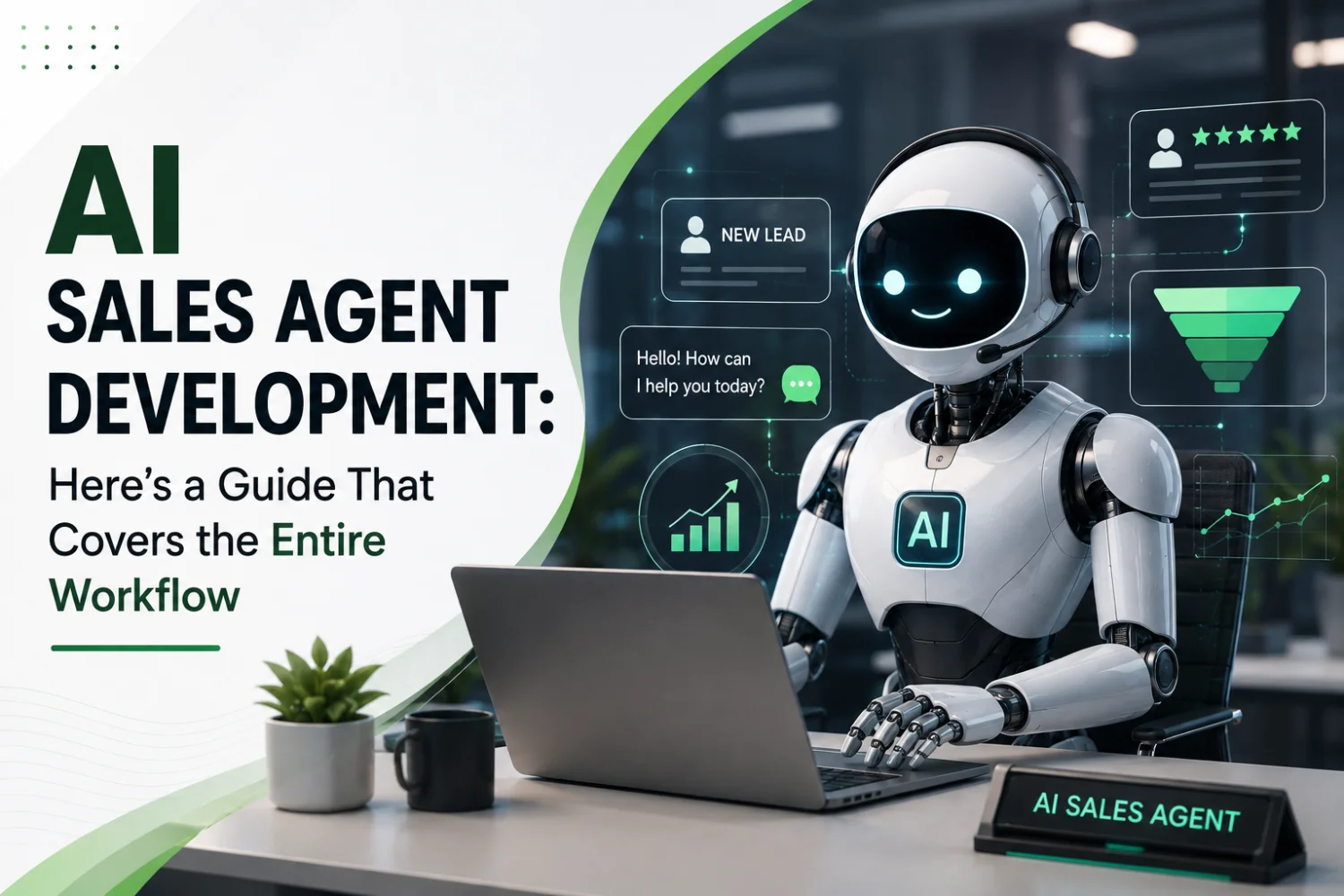
Unlike traditional chatbots that primarily answer predefined questions, an AI sales agent can understand natural-language conversations, analyze customer intent, retrieve information from business systems, qualify prospects, recommend products or services, schedule meetings, and trigger actions across a sales workflow.
According to Salesforce's State of Sales research, AI and automation are increasingly being used by sales teams to reduce administrative work and help representatives focus on higher-value activities.
For businesses considering AI sales agent development, the important question isn't simply "Can AI talk to customers?"
The more important question is:
How can an AI sales agent become a reliable part of the entire sales workflow?
This guide explains the complete AI sales agent development process—from lead capture and qualification to CRM updates, follow-ups, appointment scheduling, human handoffs, and performance optimization.
What Is an AI Sales Agent?
An AI sales agent is an AI-powered software system designed to assist or automate specific parts of the sales process.
It can communicate with prospects through channels such as:
- Website chat
- Social messaging
- Mobile applications
- Voice interfaces
Depending on its configuration, an AI sales agent can:
- Identify potential customers
- Understand customer intent
- Ask qualifying questions
- Recommend relevant products
- Retrieve information
- Update CRM records
- Schedule appointments
- Send follow-ups
- Route leads to sales representatives
- Escalate complex conversations
The key difference between an AI sales agent and a basic chatbot is actionability.
A chatbot may answer:
"Our enterprise plan starts at ₹X."
An AI sales agent could answer the question, identify that the prospect is interested in the enterprise plan, collect company details, qualify the lead, create a CRM record, and schedule a meeting with a sales representative.
AI Sales Agent vs Traditional Chatbot
| Capability | Traditional Chatbot | AI Sales Agent |
|---|---|---|
| Answer FAQs | Yes | Yes |
| Understand Natural Language | Limited–Advanced | Advanced |
| Lead Qualification | Limited | Yes |
| CRM Integration | Sometimes | Yes |
| Personalized Recommendations | Limited | Yes |
| Schedule Meetings | Limited | Yes |
| Multi-Step Actions | Limited | Yes |
| Follow-Ups | Basic | Automated |
| Decision Support | Limited | Advanced |
| Human Handoff | Yes | Yes |
| Business System Integration | Limited | Extensive |
An AI sales agent should therefore be viewed as an intelligent sales workflow, not simply a conversational interface.
Why Businesses Are Investing in AI Sales Agents
Modern buyers expect fast answers.
When someone submits an inquiry, visits a website, or sends a WhatsApp message, they may also be communicating with competitors.
A delayed response can mean a lost opportunity.
AI sales agents help businesses address several common sales challenges:
Slow Lead Response
AI can respond immediately to incoming inquiries.
High Volume of Leads
Agents can handle multiple conversations simultaneously.
Repetitive Sales Questions
Frequently asked questions can be automated.
Manual CRM Updates
Customer information can be captured and synchronized automatically.
Inconsistent Follow-Ups
Automated workflows can trigger timely follow-up messages.
Sales Team Workload
AI can handle routine conversations so sales representatives can focus on qualified opportunities.
The Complete AI Sales Agent Workflow
A well-designed AI sales agent typically follows a workflow like this:
Lead Capture
↓
Lead Identification
↓
Conversation
↓
Intent Detection
↓
Lead Qualification
↓
Data Enrichment
↓
CRM Update
↓
Lead Scoring
↓
Product Recommendation
↓
Meeting Scheduling
↓
Automated Follow-Up
↓
Human Handoff
↓
Performance Analysis
Let's explore each stage.
Step 1: Lead Capture
The workflow begins when a potential customer interacts with the business.
Common sources include:
- Website forms
- Landing pages
- Facebook or Instagram
- Google Ads
- Phone calls
- Mobile applications
The AI sales system should capture relevant information such as:
- Name
- Phone number
- Company
- Industry
- Product interest
- Business requirement
- Source of the lead
This data becomes the foundation for the next stages.
Step 2: Start the Conversation
Once a lead enters the system, the AI sales agent can initiate or respond to the conversation.
For example:
AI Agent: Hi Rahul! Thanks for contacting us. Are you looking for an automation solution for your sales, customer support, or marketing team?
The agent can adapt its questions based on the prospect's answers.
This creates a conversational experience instead of forcing prospects through a rigid form.
Step 3: Understand Customer Intent
One of the most important capabilities of an AI sales agent is intent detection.
The agent should understand what the customer actually wants.
For example:
"We currently manage around 500 leads every month and our sales team struggles to follow up with them."
The AI can identify:
Intent: Sales automation
Pain Point: Follow-up management
Lead Signal: High potential
Potential Solution: AI sales automation platform
This information can be used to personalize the next part of the conversation.
Step 4: Qualify the Lead
Not every lead has the same value.
An AI sales agent can ask qualification questions based on the company's sales methodology.
For example:
Budget
"What budget range have you allocated for this solution?"
Requirement
"What are you currently trying to automate?"
Company Size
"Approximately how large is your sales team?"
Timeline
"When are you planning to implement the solution?"
Decision Process
"Who will be involved in the final decision?"
The agent can use the answers to determine whether the prospect meets predefined qualification criteria.
Step 5: Enrich Lead Data
Lead information can be enriched using connected systems and approved data sources.
For example, after receiving a company name, the workflow could retrieve:
- Industry
- Company size
- Website
- Location
- Existing technology
- Relevant account information
The additional context can help sales representatives prioritize leads more effectively.
Step 6: Update the CRM Automatically
A major advantage of AI sales automation is eliminating repetitive CRM administration.
Instead of a sales representative manually entering information, the AI workflow can create or update a CRM record.
The workflow might look like:
Conversation
↓
Extract Lead Information
↓
Validate Data
↓
Create/Update CRM Record
↓
Add Conversation Summary
↓
Assign Lead
This helps keep customer information synchronized.
Step 7: Score the Lead
AI can assist with lead scoring by considering factors such as:
- Business size
- Purchase intent
- Budget
- Timeline
- Product interest
- Engagement level
- Previous interactions
For example:
Lead Score: 92/100
Priority: High
Reason: Strong product fit + immediate requirement + decision-maker involved.
The score can then determine what happens next.
Step 8: Recommend the Right Product or Service
A good AI sales agent shouldn't simply push the same product to every prospect.
It should understand the customer's needs and recommend the most relevant solution.
For example:
Customer Requirement:
"We need to automate customer support across WhatsApp and our website."
AI Recommendation:
"Based on your requirements, an AI chatbot integrated with WhatsApp and your CRM could automate common support queries while allowing your team to handle complex requests."
This approach creates a more consultative sales experience.
Step 9: Handle Sales Questions
Prospects often ask questions before agreeing to a meeting.
The AI sales agent can answer questions about:
- Pricing
- Features
- Integrations
- Implementation
- Security
- Support
- Product differences
- Use cases
- Deployment options
For factual information, the agent should retrieve information from approved company sources rather than relying solely on general model knowledge.
Step 10: Schedule Sales Meetings
Once a lead is qualified, the AI agent can offer available meeting slots.
For example:
"Our sales consultant is available Tuesday at 11:00 AM or Wednesday at 3:30 PM. Which works better for you?"
The system can then::
- Check calendar availability.
- Confirm the selected slot.
- Create the meeting.
- Update the CRM.
- Send confirmation.
- Trigger reminders.
This eliminates unnecessary back-and-forth between prospects and sales teams.
Step 11: Automate Follow-Ups
Many leads don't convert immediately.
An AI sales workflow can automatically follow up based on the prospect's interaction.
For example:
Day 1
"Just checking whether you'd like to continue exploring the solution."
Day 3
"Would you like us to arrange a quick demo?"
Day 7
"We're happy to answer any questions about implementation or pricing."
The timing and content should be based on business rules and customer preferences rather than sending excessive messages.
Step 12: Human Handoff
AI shouldn't attempt to handle every situation.
A human sales representative should take over when:
- The customer requests a person.
- Pricing negotiation is required.
- The prospect has complex technical requirements.
- A contract is involved.
- The conversation becomes sensitive.
- The AI lacks sufficient information.
- A high-value opportunity requires personal attention.
A strong workflow makes the transition seamless.
For example:
AI Conversation
↓
High-Value Lead Detected
↓
Sales Representative Assigned
↓
Conversation Summary Sent to CRM
↓
Human Takes Over
The salesperson doesn't need to ask the customer to repeat everything.
Step 13: Post-Meeting Follow-Up
AI can continue supporting the sales process after a meeting.
For example:
Meeting Completed
↓
CRM Updated
↓
AI Generates Summary
↓
Create Follow-Up Task
↓
Send Personalized Email
↓
Schedule Next Follow-Up
This helps maintain momentum without adding administrative work.
Step 14: Measure Performance
An AI sales agent should be evaluated using measurable business outcomes.
Important metrics include:
- Lead response time
- Qualification rate
- Meeting booking rate
- Lead-to-opportunity conversion
- Sales conversion rate
- Follow-up completion rate
- Human handoff rate
- Customer satisfaction
- Cost per qualified lead
The objective isn't to maximize the number of AI conversations.
The objective is to improve sales outcomes.
AI Sales Agent Architecture
A typical architecture might include:
Customer Channels
Website | WhatsApp | Email | Social Media
↓
AI Layer
LLM | Intent Detection | Lead Qualification | Recommendation
↓
Business Logic
Rules | Lead Scoring | Routing | Approval
↓
Integration Layer
CRM | ERP | Calendar | Payment System | Database
↓
Sales Team
Human Handoff | Notifications | Tasks | Follow-Ups
This architecture allows AI to become part of the existing sales ecosystem rather than operating as an isolated chatbot.
Technologies Used in AI Sales Agent Development
A production-ready AI sales agent may involve several technologies.
Large Language Models
Used for natural-language understanding and response generation.
CRM
Stores customer and opportunity information.
APIs
Connect the AI agent with external applications.
Databases
Store structured customer and business data.
Knowledge Bases
Provide reliable company information.
RAG
Retrieves relevant information from internal documents and knowledge sources.
Workflow Automation
Coordinates multi-step processes.
WhatsApp Business API
Enables conversational customer engagement.
Calendar Integration
Automates meeting scheduling.
AI Sales Agent Use Cases by Industry
E-Commerce
AI agents can:
- Recommend products
- Answer product questions
- Track orders
- Recover abandoned carts
- Assist with returns
Real Estate
AI can:
- Qualify property buyers
- Recommend properties
- Schedule site visits
- Capture requirements
SaaS
AI sales agents can:
- Explain product features
- Qualify trial users
- Schedule demos
- Recommend plans
Hospitality
AI can:
- Answer hotel inquiries
- Recommend rooms
- Handle booking questions
- Promote upgrades
- Schedule services
Education
AI agents can:
- Answer admission questions
- Qualify students
- Explain courses
- Schedule counseling calls
Healthcare
Subject to appropriate privacy and regulatory controls, AI can assist with administrative inquiries, appointment workflows, and lead intake without replacing qualified medical professionals.
Common Mistakes in AI Sales Agent Development
1. Treating the AI Agent Like a Chatbot
A sales agent needs access to business systems and workflows.
2. Giving AI Unlimited Access
Permissions should be restricted to only the tools required.
3. Using Unverified Information
Sales agents should use approved and current business data.
4. Automating Without Human Escalation
Complex or sensitive situations need human oversight.
5. Focusing Only on Conversation Quality
A beautiful conversation means little if it doesn't improve qualified leads or sales outcomes.
6. Ignoring CRM Integration
If the AI agent doesn't update the CRM correctly, sales teams lose valuable context.
7. Sending Too Many Follow-Ups
Automation should improve customer experience, not become spam.
Best Practices for Building a Successful AI Sales Agent
Define the Business Objective
Start with a measurable goal.
Start With a Narrow Use Case
Begin with one sales process before expanding.
Use Reliable Business Data
Connect the agent to approved information sources.
Keep Permissions Limited
Use least-privilege access for tools and systems.
Design Human Handoffs
Make escalation simple and contextual.
Track Business Metrics
Measure conversions and revenue impact—not just conversations.
Continuously Improve
Analyze failures, customer feedback, and sales outcomes to improve prompts, workflows, and integrations.
How True Value Infosoft Can Help With AI Sales Agent Development
Building an effective AI sales agent requires expertise across AI development, automation, APIs, CRM integration, software development, and business workflows.
True Value Infosoft provides AI and automation capabilities that can help businesses move from an AI concept to a customized production solution.
Depending on the project, our services can include:
- AI Agent Development
- Generative AI Development
- AI Chatbot Development
- AI Sales Automation
- WhatsApp Business API Integration
- CRM & ERP Integration
- API Integration
- RAG & Knowledge Base Solutions
- Custom Software Development
- Workflow Automation
- Cloud Deployment
- AI Solution Consulting
For example, an AI sales agent for a business could connect a website or WhatsApp conversation with the company's CRM, lead database, calendar, knowledge base, and internal workflows.
The result is a connected sales process where AI handles repetitive interactions while human sales professionals focus on qualified opportunities and relationship building.
Conclusion
AI sales agent development is not simply about adding an AI chatbot to a website.
A successful AI sales agent should be part of the entire sales workflow—from lead capture and intent detection to qualification, CRM updates, lead scoring, recommendations, appointment scheduling, follow-ups, and human handoffs.
The most effective systems combine AI's ability to understand natural language with reliable business rules, trusted data, automation workflows, and human oversight.
For businesses, this can mean faster lead response, more consistent follow-ups, reduced administrative work, and a more personalized buying experience.
If your organization is considering an AI sales agent, True Value Infosoft can help you design a solution around your sales process, technology stack, and business goals.
Ready to automate and scale your sales workflow? Contact True Value Infosoft to explore a customized AI sales agent for your business.