Introduction
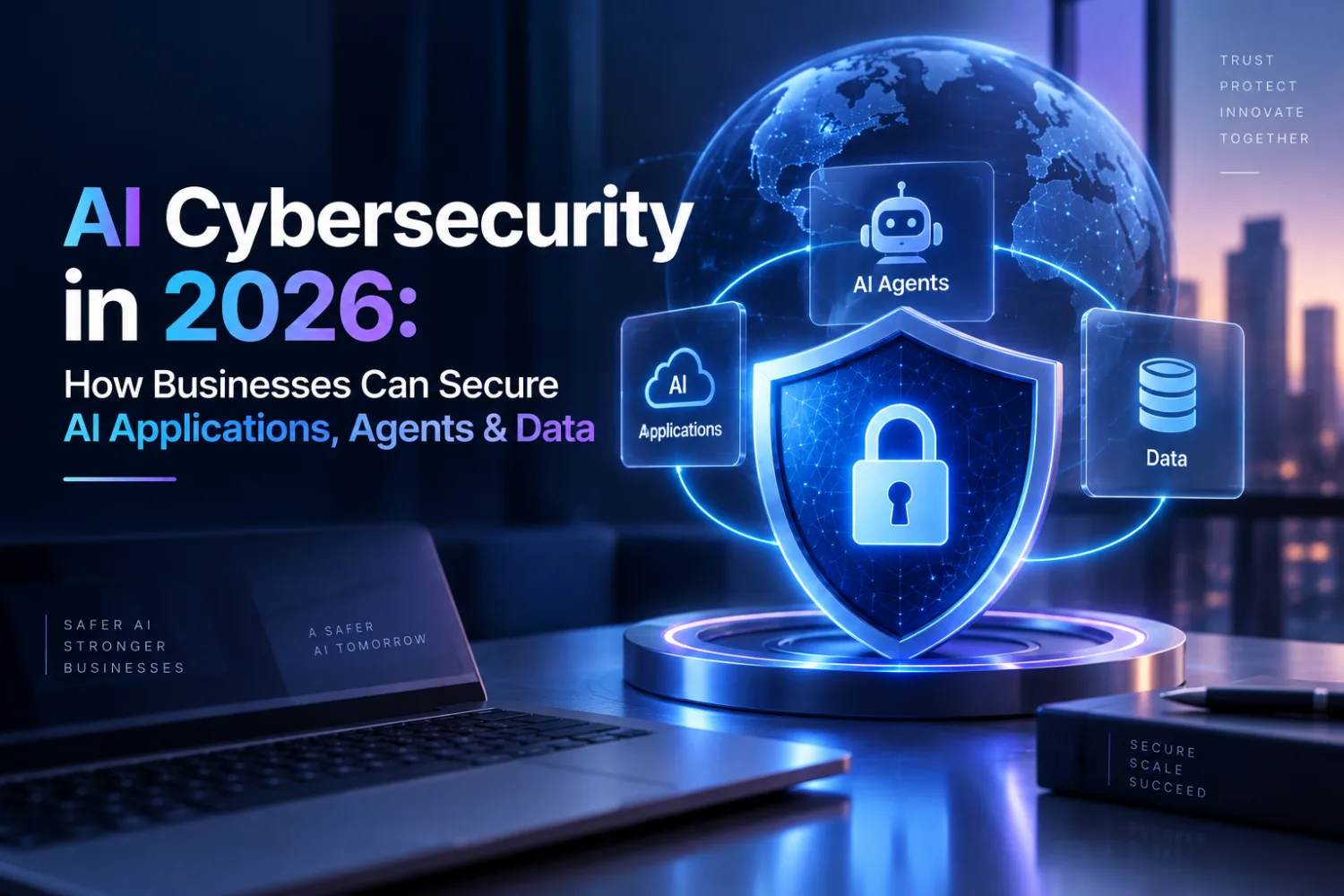
Artificial Intelligence has become deeply embedded in modern business applications. Companies are using generative AI, large language models (LLMs), AI copilots, intelligent chatbots, predictive analytics, and autonomous AI agents to automate processes and make faster decisions.
But as AI becomes more capable, the security challenge also becomes more complex.
Traditional cybersecurity controls alone may not adequately address risks such as prompt injection, sensitive information disclosure, model manipulation, insecure AI integrations, excessive agent permissions, and attacks against RAG systems. OWASP's GenAI Security Project specifically identifies risks such as prompt injection, supply-chain vulnerabilities, data and model poisoning, excessive agency, system prompt leakage, and vector/embedding weaknesses.
In 2026, businesses therefore need to think beyond securing servers and applications. They also need to secure AI models, prompts, data pipelines, APIs, agents, tools, knowledge bases, and the decisions made by AI systems.
This guide explains the major AI cybersecurity risks businesses should understand in 2026 and practical strategies for building safer AI applications and agentic systems.
What Is AI Cybersecurity?
AI cybersecurity refers to the practices, technologies, and controls used to protect artificial intelligence systems from unauthorized access, manipulation, data leakage, malicious inputs, abuse, and operational failures.
It covers the entire AI lifecycle, including:
- Data collection and preparation
- Model development and training
- AI application development
- API and model integration
- RAG and vector databases
- AI agents and tool access
- Deployment and infrastructure
- Monitoring and incident response
Unlike conventional software, AI systems can interpret natural-language inputs, generate unpredictable outputs, retrieve information from multiple sources, and—when designed as agents—take actions through external tools.
That creates a broader security surface.
NIST's AI Risk Management Framework and its Generative AI Profile provide organizations with structured approaches for identifying and managing AI-related risks across the AI lifecycle.
Why AI Security Matters More in 2026
AI adoption is moving from experimentation toward business-critical applications.
Businesses are increasingly using AI for:
- Customer support
- Software development
- Financial analysis
- Recruitment
- Healthcare applications
- Fraud detection
- Document processing
- Business intelligence
- Marketing automation
- Enterprise search
- Workflow automation
- Decision support
True Value Infosoft's AI development work includes AI applications, automation, chatbots, predictive analytics, and enterprise AI integration.
As AI becomes connected to more business systems, a security incident can potentially expose not only application data but also internal documents, customer information, credentials, APIs, and business processes.
The security model therefore needs to evolve alongside the AI architecture.
Top AI Cybersecurity Risks Businesses Need to Address
1. Prompt Injection Attacks
Prompt injection is one of the most important security concerns for LLM-powered applications.
An attacker may construct an input that attempts to manipulate the model into ignoring its intended instructions or performing an unauthorized task.
For example, an AI customer-support system might have access to internal knowledge sources. A malicious user could attempt to manipulate the system into revealing information that should never be exposed.
OWASP lists prompt injection as LLM01 in its 2025 Top 10 for LLM applications.
How businesses can reduce the risk
Organizations should consider:
- Separating system instructions from untrusted user content
- Validating inputs
- Limiting model permissions
- Using structured tool calls
- Applying output validation
- Monitoring suspicious prompts
- Performing adversarial testing
Prompt filtering alone should not be treated as a complete security solution. AI systems should be designed with multiple security boundaries.
2. Sensitive Data Disclosure
AI applications frequently interact with sensitive information.
This can include:
- Customer records
- Employee information
- Financial data
- Internal documents
- API credentials
- Business strategies
- Source code
- Contracts
If access controls are poorly designed, an AI assistant may unintentionally expose information to an unauthorized user.
OWASP identifies sensitive information disclosure as a major risk for LLM applications.
Security practices
Businesses should implement:
- Role-based access control
- Data classification
- Encryption
- Secure secret management
- Data minimization
- Tenant isolation
- Access logging
- Permission-aware retrieval
An important principle is simple:
The AI should never have access to more information than it needs to perform its task.
3. Excessive Agency in AI Agents
AI agents represent a major shift from traditional chatbots.
A chatbot generally responds to a user.
An AI agent can potentially:
- Understand a request
- Plan a task
- Call an API
- Access a database
- Use external tools
- Make decisions
- Execute an action
This additional autonomy creates additional security risks.
OWASP has separately published guidance for Agentic AI security, highlighting risks associated with autonomous systems and their ability to interact with tools and make decisions.
The principle of least privilege
An AI agent should receive only the permissions required for its specific task.
For example, an AI sales assistant may need permission to:
- Read CRM leads
- Create follow-up tasks
- Draft emails
It may not need permission to:
- Delete customer records
- Modify billing information
- Export the entire CRM database
For high-impact actions, businesses should consider requiring human approval.
4. RAG and Vector Database Security
Retrieval-Augmented Generation (RAG) has become a common architecture for enterprise AI.
RAG allows an AI system to retrieve relevant information from company documents or databases before generating a response. This can help businesses build AI assistants that work with internal knowledge.
However, RAG introduces additional security considerations.
Potential risks include:
- Unauthorized document retrieval
- Cross-tenant data exposure
- Malicious documents
- Poisoned knowledge sources
- Insecure embeddings
- Incorrect access filtering
OWASP specifically added Vector and Embeddings Weaknesses to its 2025 LLM risk framework.
Secure RAG architecture
A secure RAG implementation should consider:
User → Authentication → Authorization → Query → Permission-Aware Retrieval → Trusted Knowledge → LLM → Output Validation
The retrieval layer should respect the user's existing permissions rather than assuming that anything indexed in the vector database is accessible to everyone.
5. AI Supply Chain Attacks
Modern AI applications often depend on multiple components:
- Foundation models
- Open-source libraries
- APIs
- Plugins
- Datasets
- Model repositories
- Vector databases
- Third-party services
Every external dependency creates another potential attack surface.
OWASP identifies supply-chain vulnerabilities as one of the major risks affecting LLM applications.
Businesses should evaluate:
- Where models originate
- What datasets are being used
- Which third-party APIs are connected
- Whether dependencies are maintained
- What permissions external services receive
- How model and package updates are validated
AI security should therefore include traditional software supply-chain security as well as AI-specific controls.
6. Data and Model Poisoning
AI systems depend heavily on data.
If malicious or incorrect information enters a training dataset, fine-tuning dataset, knowledge base, or retrieval system, it can potentially influence system behavior.
Potential sources include:
- Compromised datasets
- Malicious documents
- Untrusted web content
- Manipulated training data
- Unauthorized knowledge-base updates
OWASP lists data and model poisoning among the major GenAI application risks.
Protection strategies
Organizations can reduce exposure through:
- Trusted data sources
- Dataset validation
- Data provenance
- Access controls
- Versioning
- Change monitoring
- Human review for critical knowledge
7. Insecure AI Outputs
AI-generated output should not automatically be considered trustworthy.
An AI model could produce:
- Incorrect information
- Unsafe commands
- Malicious content
- Invalid SQL
- Unsafe code
- Unexpected API parameters
If the application directly executes an AI-generated command without validation, the AI output can become an attack pathway.
OWASP identifies improper output handling as a specific LLM application risk.
Better approach
Treat AI output as untrusted input.
Applications should validate, sanitize, constrain, and authorize AI-generated actions before executing them.
8. Authentication and Authorization
AI applications should follow the same fundamental security principles as other enterprise applications.
Every user should have an appropriate identity and permission level.
For AI agents, authorization becomes even more important because the agent may act on behalf of a user.
For example:
User → AI Agent → CRM → Customer Data
The agent should not automatically receive unrestricted CRM access simply because it needs to retrieve one type of customer record.
Organizations should implement:
- Strong authentication
- Role-based access control
- Least-privilege permissions
- Short-lived credentials
- API authorization
- Session management
- Audit logs
9. AI API and Integration Security
Most enterprise AI applications depend on APIs.
An AI system may communicate with:
- CRM platforms
- ERP systems
- Payment gateways
- HR platforms
- Databases
- Communication tools
- Cloud services
Every integration needs appropriate authentication, authorization, rate limiting, validation, and monitoring.
API keys and secrets should never be placed directly inside prompts or exposed to users.
For applications using external AI APIs, businesses should also review:
- Data handling policies
- Retention practices
- Authentication mechanisms
- API permissions
- Rate limits
- Logging
- Vendor security controls
10. AI Monitoring and Incident Response
Security does not end when an AI application goes live.
AI behavior can change because of:
- New models
- New prompts
- New data
- New tools
- New integrations
- Updated dependencies
- Changes in user behavior
Organizations should continuously monitor AI applications for unusual activity.
Useful signals include:
- Abnormal API usage
- Repeated prompt injection attempts
- Unexpected data retrieval
- Unusual agent actions
- Excessive token consumption
- Failed authorization requests
- Suspicious tool calls
Security teams should also define an incident-response process specifically for AI systems.
AI Security Architecture for Modern Businesses
A secure AI architecture should use multiple layers instead of relying on one security mechanism.
A practical architecture can include:
Layer 1: Identity
Authenticate users and services before allowing access.
Layer 2: Authorization
Determine exactly what the user or AI agent is allowed to access.
Layer 3: Data Security
Protect sensitive information through encryption, classification, isolation, and access controls.
Layer 4: AI Gateway
Control communication between applications and AI models.
Layer 5: Prompt & Input Security
Detect suspicious or malicious inputs.
Layer 6: Model Security
Secure model access, configurations, versions, and dependencies.
Layer 7: Tool Security
Restrict which APIs and tools AI agents can access.
Layer 8: Output Validation
Validate AI-generated content before it reaches users or downstream systems.
Layer 9: Monitoring
Track AI behavior, access patterns, and security events.
Layer 10: Human Oversight
Require human approval for high-risk or irreversible actions.
This layered approach aligns with the broader risk-management philosophy behind NIST's AI RMF and the security guidance emerging from OWASP's GenAI initiatives.
AI Cybersecurity Best Practices for 2026
Businesses developing or adopting AI should consider the following checklist.
1. Perform AI Threat Modeling
Before deployment, identify:
- What data the AI can access
- Who can use it
- Which tools it can call
- What actions it can perform
- What happens if the model is manipulated
2. Apply Least Privilege
Give AI applications and agents the minimum permissions required.
3. Protect Sensitive Data
Use encryption, access controls, data classification, and secure secret management.
4. Secure RAG Pipelines
Ensure retrieval respects document-level and user-level permissions.
5. Validate AI Outputs
Never automatically trust model-generated commands or structured data.
6. Test Against Adversarial Inputs
Security testing should include prompt injection, data leakage, malicious documents, tool abuse, and other AI-specific attack scenarios.
OWASP recommends adversarial testing and attack simulations as part of securing LLM applications.
7. Monitor AI Agents
Log tool calls, permissions, data access, and important decisions.
8. Establish Human Approval
High-impact actions should have appropriate human oversight.
9. Secure the AI Supply Chain
Review models, datasets, libraries, APIs, and third-party services.
10. Make Security Part of the AI Lifecycle
Security should begin during architecture and continue through development, testing, deployment, and maintenance.
AI Security Testing: What Should Businesses Test?
Before releasing an AI application, organizations should test both traditional and AI-specific vulnerabilities.
A practical AI security testing program can include:
| Testing Area | What to Check |
|---|---|
| Prompt Security | Prompt injection and instruction manipulation |
| Data Security | Unauthorized information disclosure |
| Access Control | User and agent permissions |
| RAG Security | Unauthorized document retrieval |
| API Security | Authentication and authorization |
| Agent Security | Unsafe tool usage |
| Output Security | Malicious or invalid generated output |
| Supply Chain | Third-party models and dependencies |
| Availability | Resource exhaustion and abuse |
| Monitoring | Detection of suspicious activity |
The traditional OWASP Top 10 also remains relevant because AI applications are still software applications. Its 2025 list includes risks such as broken access control, security misconfiguration, supply-chain failures, cryptographic failures, injection, authentication failures, and logging/alerting failures.
How True Value Infosoft Can Help Build Secure AI Solutions
Building an AI solution is not simply about connecting an LLM API to an application.
Businesses need an architecture that considers security, scalability, data protection, integrations, performance, and long-term maintenance.
True Value Infosoft provides AI Development Services covering AI applications, machine learning, NLP, computer vision, predictive analytics, AI automation, and intelligent business solutions.
The company also works with Generative AI Solutions and enterprise AI integration approaches such as API-based integrations, custom AI models, RAG architectures, and AI workflow automation.
For organizations building AI-powered products, relevant capabilities can include:
- Secure AI application architecture
- Custom AI development
- Generative AI integration
- AI chatbot development
- RAG-based enterprise assistants
- AI agent development
- Machine learning solutions
- AI-powered automation
- API and third-party integration
- Data and access-control architecture
- AI testing and optimization
- Ongoing AI maintenance and support
Businesses can also Hire AI Developers when they need specialized AI engineering expertise for a new project or existing AI platform.
The goal should not simply be to make AI powerful.
It should be to make AI useful, controlled, auditable, and secure.
A Practical AI Security Roadmap for Businesses
Companies don't necessarily need to implement every security control at once.
A phased approach can be more practical.
Phase 1: Discover
Identify:
- Existing AI applications
- AI vendors
- Models
- APIs
- Data sources
- AI agents
- Business-critical use cases
Phase 2: Assess
Conduct:
- AI threat modeling
- Data-flow analysis
- Permission reviews
- Vulnerability assessment
- AI-specific security testing
Phase 3: Protect
Implement:
- Authentication
- Authorization
- Encryption
- Secure APIs
- Data isolation
- Input/output controls
- Agent permission boundaries
Phase 4: Test
Perform:
- Adversarial testing
- Prompt-injection testing
- Data-leakage testing
- RAG security testing
- Agent/tool abuse testing
Phase 5: Monitor
Track:
- User activity
- AI requests
- Data access
- Agent actions
- API activity
- Security alerts
Phase 6: Improve
AI security should be continuously updated as models, applications, integrations, and threats evolve.
The Future of AI Cybersecurity
The security conversation around AI is moving beyond traditional model security.
As businesses adopt more autonomous systems, the focus will increasingly include:
- Agent identity
- Agent authorization
- Secure tool use
- AI-to-AI communication
- Continuous AI monitoring
- Automated security testing
- AI governance
- Secure model supply chains
- Privacy-preserving AI
- Human oversight for high-impact decisions
OWASP's release of dedicated guidance for Agentic AI security reflects this shift from securing only LLM applications toward securing systems where AI can plan, interact with tools, and take actions.
NIST is also continuing to develop AI cybersecurity guidance; its preliminary Cyber AI Profile focuses on helping organizations address cybersecurity risks associated with AI adoption.
Conclusion
AI is becoming an essential part of modern business technology, but increased AI adoption also introduces new security challenges.
In 2026, businesses should secure more than just their applications and infrastructure. They need to consider the security of AI models, prompts, datasets, APIs, RAG pipelines, vector databases, agents, tools, and generated outputs.
A secure AI strategy should combine traditional application security with AI-specific practices such as prompt-injection defense, least-privilege agent access, secure RAG architecture, output validation, adversarial testing, monitoring, and human oversight.
For organizations planning to build or modernize an AI solution, True Value Infosoft can help design and develop scalable AI systems with security considerations built into the architecture from the beginning.
Ready to build a secure AI application, AI agent, or enterprise AI platform? Connect with True Value Infosoft to discuss your AI development requirements and create a future-ready solution.