Introduction
Sales teams today are under constant pressure to close deals faster, improve customer engagement, and personalize communication at scale. Traditional CRM systems help organize customer data, but they often fall short in generating actionable insights in real time.
This is where Generative AI changes the game.
Generative AI-powered sales systems can automate lead qualification, generate personalized emails, summarize calls, recommend next actions, and even predict deal outcomes. Instead of relying only on manual workflows, businesses can build intelligent systems that act as AI-powered sales assistants.
At True Value Infosoft, we help organizations build AI-driven software solutions that transform sales operations with automation, predictive intelligence, and scalable architecture.
What Is a Generative AI Sales System?
A Generative AI sales system uses Large Language Models (LLMs) and machine learning to assist sales teams in:
- Lead scoring and qualification
- Automated email generation
- Sales call summarization
- Proposal drafting
- CRM data enrichment
- Customer intent analysis
- Personalized recommendations
Instead of static dashboards, sales teams get dynamic AI-generated insights.
Example:
A sales representative finishes a Zoom call.
The AI system automatically:
- Transcribes the call
- Summarizes key discussion points
- Detects objections
- Updates CRM notes
- Suggests the next follow-up message
This reduces manual work and improves sales efficiency.
Core Architecture of a Generative AI Sales Platform
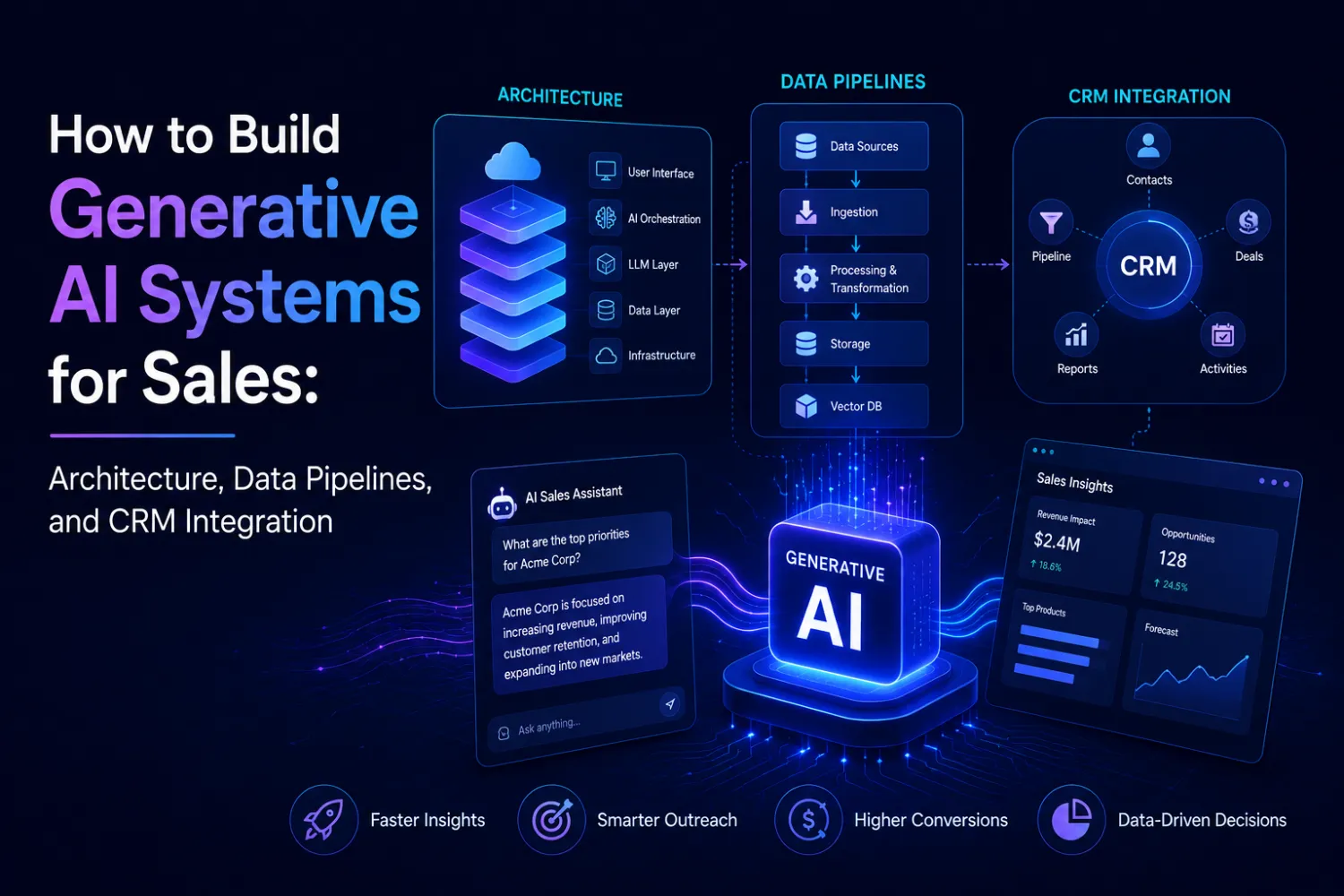
A scalable Generative AI sales system typically has 5 major layers.
1. Data Collection Layer
This layer gathers data from multiple sales channels:
- CRM platforms
- Emails
- Chat conversations
- Sales call recordings
- Website interactions
- Marketing automation tools
- Customer support systems
Common integrations include:
- Salesforce
- HubSpot
- Zoho CRM
- Slack
- Zoom
The richer your data, the smarter your AI.
2. Data Pipeline Layer
Raw data is messy. AI systems require structured and clean data.
A robust data pipeline performs:
Data Extraction
Pulling records from APIs, databases, and cloud systems.
Data Cleaning
Removing duplicates, missing values, and irrelevant content.
Transformation
Converting raw data into AI-ready formats.
Example:
Raw CRM Note:
“Client interested in enterprise plan, budget uncertain, follow-up next week.”
Structured Data:
Storage
Processed data is stored in:
- Data warehouses
- Vector databases
- Cloud storage
- Relational databases
Popular technologies:
- PostgreSQL
- MongoDB
- Snowflake
- Vector DBs for embeddings
3. AI Intelligence Layer
This is the brain of the system.
It contains:
Large Language Models (LLMs)
Used for:
- Text generation
- Summarization
- Email drafting
- Proposal creation
Popular LLMs:
- ChatGPT
- Claude
- Gemini
Embeddings + Retrieval
Generative AI becomes far more useful when it can retrieve company-specific data.
Example:
Sales rep asks:
“What objections did this client raise last month?”
Instead of hallucinating, the AI searches past conversations and returns accurate answers.
This architecture is called RAG (Retrieval-Augmented Generation).
Benefits:
- More accurate AI responses
- Reduced hallucinations
- Better enterprise security
- Context-aware generation
4. Automation & Workflow Engine
AI becomes powerful when connected to workflows.
Example automation rules:
Lead Qualification
If lead score > 85
→ Assign to senior sales rep
Follow-Up Reminder
No customer response in 3 days
→ Generate follow-up email
Upsell Opportunity
Customer using premium features
→ Notify account manager
Tools often used:
- Workflow engines
- APIs
- Event-driven systems
- Webhooks
This turns AI into an active sales assistant.
5. CRM Integration Layer
Without CRM integration, AI cannot create business value.
CRM integration allows AI to:
- Read customer history
- Update records automatically
- Create tasks
- Track opportunities
- Trigger workflows
Example:
After a meeting, AI updates CRM:
Before
- Notes missing
- No next step
- Lead status unchanged
After AI
- Summary added
- Opportunity score updated
- Follow-up task created
- AI-generated email ready
This saves hours every week.
Real-World Use Cases
AI Email Generation
Generative AI writes personalized emails using:
- Customer name
- Industry
- Past interactions
- Pain points
Example output:
Hi John, based on our last conversation, I believe our AI automation solution could reduce your sales team's manual workload by 40%...
Sales Call Summaries
AI extracts:
- Requirements
- Pain points
- Competitors
- Budget signals
- Urgency
No manual note-taking needed.
Smart Lead Scoring
AI analyzes:
- Website visits
- Email opens
- Demo requests
- CRM history
Then predicts conversion probability.
Example:
- Lead A → 82% chance to convert
- Lead B → 27% chance
Sales reps focus on high-value opportunities.
Challenges in Building Generative AI Sales Systems
Building enterprise AI is not just about plugging in an API.
Major challenges include:
Data Quality Issues
Bad CRM data leads to bad AI outputs.
Security & Compliance
Sensitive sales data must remain protected.
Hallucination Risk
LLMs may generate inaccurate responses without context.
Integration Complexity
CRMs, ERPs, and internal tools often use different schemas.
This is why architecture matters.
Best Practices for Implementation
To successfully build AI sales systems:
Start Small
Begin with one use case:
- Email generation
OR
- Call summarization
Use Human-in-the-Loop
Let sales reps approve AI-generated outputs initially.
Build Feedback Loops
Use user corrections to improve AI performance.
Monitor AI Performance
Track:
- Accuracy
- Adoption
- Conversion uplift
- Time saved
Future of AI in Sales
The next generation of sales teams will work alongside AI agents.
Future capabilities include:
- AI SDRs (Sales Development Representatives)
- Voice AI for cold calls
- Autonomous lead nurturing
- Predictive deal closing
- AI negotiation assistants
Companies adopting AI early will gain a major competitive advantage.
How True Value Infosoft Helps
At True Value Infosoft, we specialize in building production-ready AI solutions for businesses looking to scale with automation. Our expertise includes:
- Generative AI systems
- AI Agents
- CRM integrations
- RAG architecture
- LLM integration
- Custom sales automation platforms
- Web and mobile AI products
Whether you want to build an AI-powered CRM assistant or a full enterprise sales intelligence platform, our team can help design, develop, and deploy the right solution.
Conclusion
Generative AI is reshaping how sales teams operate.
The combination of:
- Scalable architecture
- Reliable data pipelines
- AI intelligence
- CRM integration
creates powerful systems that increase productivity, improve customer engagement, and drive revenue.
Businesses that invest in AI today will define the future of sales tomorrow.
Ready to Build AI for Your Sales Team?
Partner with True Value Infosoft to build intelligent AI-powered sales systems tailored to your business.