Introduction
Businesses are moving beyond traditional automation. In 2026, the next major shift is autonomous AI—systems that can understand objectives, make decisions, use business tools, and complete multi-step tasks with limited human intervention.
Unlike conventional software automation, which generally follows predefined rules, AI agents for business can reason about changing situations and determine what action should happen next.
From sales and customer support to finance, HR, operations, and IT, AI agents are becoming a practical way for organizations to automate repetitive work while allowing employees to focus on higher-value activities.
Industry adoption is accelerating, but successful implementation requires more than simply connecting a large language model to a workflow. Businesses need the right architecture, integrations, security controls, human oversight, and measurable business objectives.
This is where AI Agent Development becomes strategically important.
What Are AI Agents?
An AI agent is a software system capable of perceiving information, reasoning about a task, taking actions through connected tools, and evaluating the outcome.
A traditional chatbot may answer:
"What is the status of my order?"
An AI agent can potentially go further:
- Identify the customer.
- Retrieve the order from the CRM or eCommerce system.
- Check the latest shipment status.
- Determine whether the order is delayed.
- Update the customer.
- Create a support ticket if intervention is required.
- Follow up automatically when the issue is resolved.
The key difference is action.
Traditional AI primarily responds to requests. Agentic AI can be designed to pursue a defined goal by selecting and executing appropriate actions.
Modern enterprise AI platforms are increasingly moving toward this model, with agents connecting to business applications, APIs, databases, and enterprise workflows.
AI Agents vs Traditional Automation
Traditional automation is excellent when a process is predictable.
For example:
When an invoice is received → extract the invoice number → save the document → send an email.
But real-world business processes are rarely this simple.
An invoice may have missing information, an unusual amount, a duplicate record, or a supplier that requires additional verification.
An AI agent can be designed to evaluate the situation and determine the next appropriate step.
| Traditional Automation | AI Agents |
|---|---|
| Rule-based workflows | Goal-oriented workflows |
| Predefined conditions | Context-aware decisions |
| Limited flexibility | Can adapt to changing situations |
| Usually follows fixed sequences | Can determine the next action |
| Requires structured inputs | Can work with unstructured information |
| Best for predictable processes | Useful for complex, multi-step processes |
This does not mean AI agents should replace every automation system.
Instead, the most effective architecture often combines conventional automation with AI agents where reasoning, interpretation, or decision-making is required.
Why AI Agents Matter for Businesses in 2026
The business case for autonomous AI is becoming stronger because organizations are dealing with increasing amounts of data, customer interactions, documents, and operational complexity.
AI agents can help businesses address several challenges simultaneously.
1. Automating Repetitive Knowledge Work
Employees spend significant time searching for information, updating systems, preparing reports, responding to routine requests, and moving data between applications.
An AI agent can handle portions of these workflows automatically.
For example, a sales operations agent could:
- Monitor incoming leads
- Enrich lead information
- Analyze customer requirements
- Update the CRM
- Prioritize opportunities
- Prepare follow-up messages
- Schedule meetings
- Notify sales representatives about high-value prospects
This allows sales teams to spend more time on conversations and relationship building.
2. 24/7 Business Operations
Human teams operate within working hours. Autonomous software can operate continuously.
A properly designed AI agent can monitor events, process requests, perform scheduled tasks, and escalate exceptions around the clock.
For businesses serving customers across multiple time zones, this can be especially valuable.
3. Faster Decision Support
AI agents can bring together information from multiple sources before recommending or executing an action.
For example, an operations agent could combine:
- Inventory data
- Sales forecasts
- Supplier information
- Order history
- Delivery information
It could then identify potential inventory problems and notify the appropriate team.
The goal isn't necessarily to give the AI unlimited decision-making authority. Instead, businesses can define which decisions an agent can make independently and which require human approval.
4. Reduced Operational Costs
When repetitive tasks are automated, employees can spend less time performing manual administrative work.
Potential benefits include:
- Lower processing time
- Fewer repetitive tasks
- Reduced manual data entry
- Faster customer responses
- Improved employee productivity
- Better utilization of existing systems
However, organizations should measure these outcomes rather than assuming automation automatically produces ROI.
How AI Agents Are Transforming Different Business Functions
The applications of autonomous AI extend across virtually every department.
AI Agents for Sales
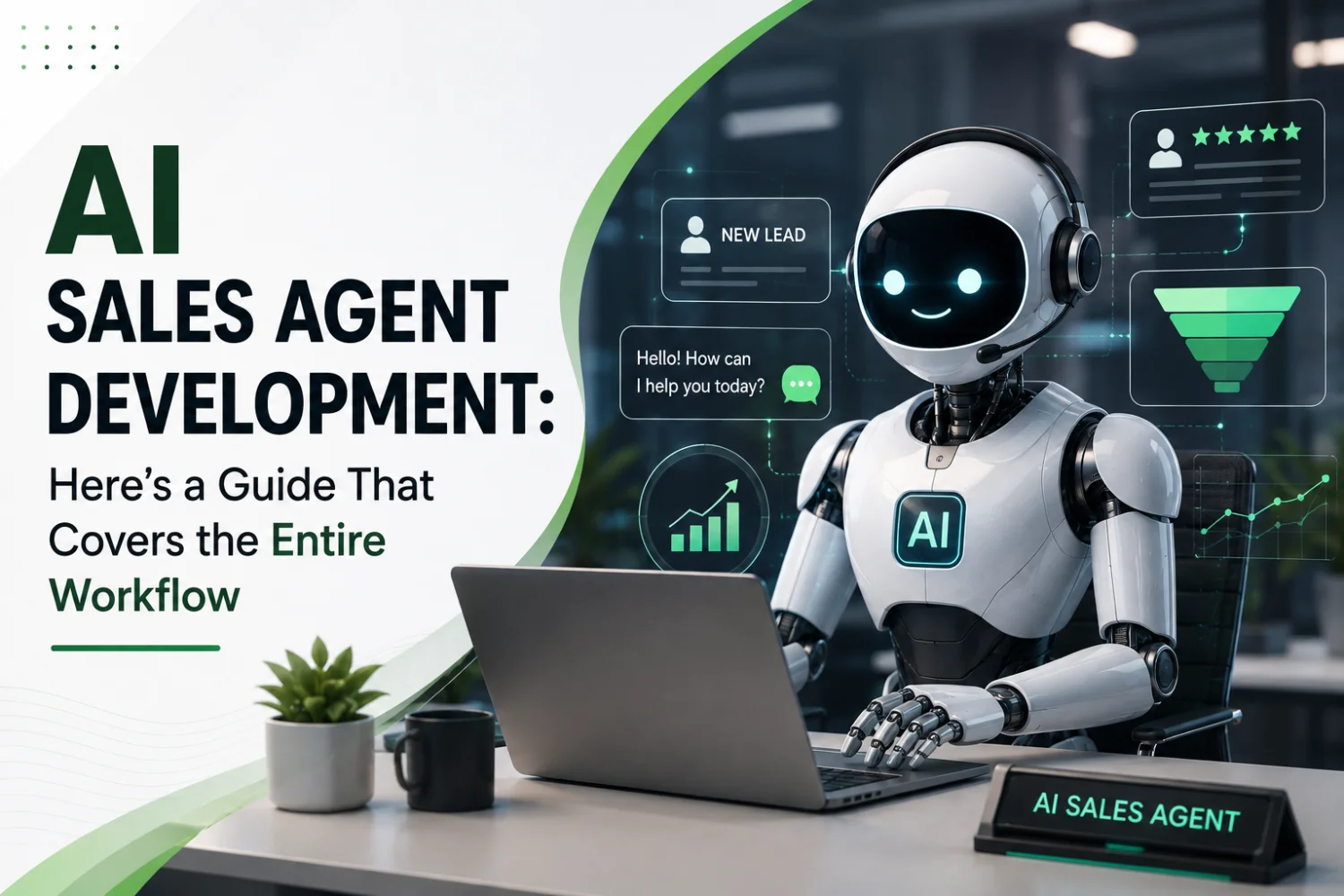
Sales teams can use agents to automate parts of the lead lifecycle.
A sales agent can help:
- Identify potential prospects
- Research companies
- Qualify leads
- Enrich customer profiles
- Update CRM records
- Draft personalized outreach
- Schedule meetings
- Follow up with prospects
For organizations managing high volumes of leads, agent-based workflows can significantly reduce manual coordination.
Businesses can also combine agents with AI Integration Services to connect CRM platforms, communication tools, databases, and internal applications.
AI Agents for Customer Support
Customer service is one of the most natural use cases for autonomous AI.
An AI support agent can:
- Understand the customer's question.
- Search relevant knowledge.
- Retrieve account information.
- Determine the appropriate response.
- Execute permitted actions.
- Escalate complex cases to a human agent.
This can go beyond simple FAQ chatbots.
For example, a customer could ask an agent to change an appointment. The agent could verify the customer, check availability, update the booking system, and confirm the new appointment.
This approach can be combined with AI Chatbot Development and existing helpdesk systems to create more capable customer experiences.
AI Agents for Finance
Finance departments deal with large amounts of structured and unstructured information.
Potential AI agent applications include:
- Invoice processing
- Expense verification
- Payment follow-ups
- Financial reporting
- Document analysis
- Reconciliation assistance
- Fraud-risk flagging
- Accounts receivable workflows
For sensitive financial processes, agents should operate within clearly defined permissions and approval thresholds.
AI Agents for Human Resources
HR teams can use AI agents to automate administrative processes such as:
- Candidate screening
- Interview scheduling
- Employee onboarding
- HR policy queries
- Document collection
- Employee support
- Internal knowledge retrieval
AI can also support recruiters by matching candidates against job requirements, although organizations should maintain appropriate human oversight for employment-related decisions.
AI Agents for Operations
Operations teams can benefit from agents that continuously monitor systems and identify exceptions.
Examples include:
- Inventory monitoring
- Order management
- Supplier communication
- Logistics coordination
- Maintenance alerts
- Workflow monitoring
- Operational reporting
A multi-agent architecture can divide complex workflows between specialized agents.
For example:
Order Agent → Inventory Agent → Logistics Agent → Customer Communication Agent
Each agent can perform a specialized role while an orchestration layer coordinates the overall process.
Multi-Agent AI: The Next Evolution
One of the most important developments in autonomous AI is the rise of multi-agent systems.
Instead of asking one AI agent to perform every task, businesses can create specialized agents that collaborate.
Imagine an eCommerce business receiving a large order.
A multi-agent workflow might contain:
Order Agent
Validates the order and customer information.
↓
Inventory Agent
Checks product availability.
↓
Pricing Agent
Validates discounts and pricing rules.
↓
Logistics Agent
Selects an appropriate delivery option.
↓
Customer Agent
Communicates the order confirmation.
This architecture can make complex business workflows easier to organize and scale.
True Value Infosoft specifically provides Multi-Agent Pipelines designed to coordinate specialized agents for complex, multi-step business processes.
AI Agents Need Business System Integration
An AI agent without access to relevant business systems has limited ability to create real operational value.
The real transformation happens when AI agents can securely interact with existing technology.
For example:
AI Agent + CRM + ERP + Database + Email + WhatsApp + APIs
This enables the agent to move from simply generating text to actually completing business tasks.
True Value Infosoft's AI capabilities include integrations with systems such as CRM platforms, Odoo, and Shopify, along with API-based integration and compatibility with existing systems.
This makes AI Integration Services an important component of an enterprise agent strategy.
AI Agents and Business Process Automation
AI agents and automation work particularly well together.
Consider a traditional workflow:
Lead Received → CRM Entry → Qualification → Email → Follow-up → Sales Notification
Instead of manually managing every step, an AI-powered workflow can analyze the lead, determine its priority, update the CRM, generate a personalized message, schedule follow-ups, and alert a salesperson when human intervention is needed.
This combination of reasoning and workflow execution is where AI Automation can deliver significant operational value.
True Value Infosoft offers AI-powered workflow automation designed to reduce manual work, integrate third-party applications, and support real-time monitoring.
AI Agents vs AI Copilots
AI agents and AI copilots are related but serve different purposes.
AI Copilot
A copilot primarily assists a human.
For example:
"Summarize this sales report."
The human reviews the result and decides what to do.
AI Agent
An agent can potentially perform the next steps itself.
For example:
"Analyze this month's sales performance and identify accounts requiring follow-up."
The agent could analyze the data, identify accounts, prepare recommendations, and—if authorized—create follow-up tasks.
True Value Infosoft also develops AI Copilot Development solutions for contextual assistance, natural-language commands, and workflow support inside applications.
The right choice depends on how much autonomy the business process actually requires.
What Does an AI Agent Architecture Look Like?
A production-ready AI agent typically contains several components.
1. Large Language Model
The model provides reasoning and language capabilities.
2. Agent Orchestration Layer
This determines how tasks are planned, executed, and coordinated.
3. Tools and APIs
These allow the agent to interact with business applications.
4. Business Data
The agent needs access to relevant information from approved sources.
5. Memory and Context
Memory mechanisms can help agents maintain relevant information across interactions.
6. Guardrails
Rules and permissions define what the agent can and cannot do.
7. Monitoring
Organizations need visibility into agent actions, failures, costs, and performance.
8. Human Escalation
High-risk or ambiguous actions should be routed to people.
A strong architecture therefore looks less like a chatbot and more like a controlled software system.
Security and Governance Are Critical
Autonomy introduces new risks.
An AI agent may have access to sensitive information and business systems. If poorly designed, it could make an incorrect decision, access inappropriate data, or perform an unauthorized action.
Organizations should therefore establish:
- Role-based access
- Least-privilege permissions
- Approval workflows
- Audit logs
- Data protection controls
- Prompt-injection defenses
- Monitoring and alerting
- Human escalation
- Agent testing and evaluation
- Clear ownership and accountability
Recent industry discussions around enterprise AI agents increasingly emphasize governance, observability, and controlled autonomy rather than simply maximizing what agents are allowed to do.
The objective should not be maximum autonomy.
It should be useful autonomy with appropriate control.
How to Identify the Right AI Agent Use Case
Not every business process needs an autonomous agent.
A good candidate usually has several of these characteristics:
- High task volume
- Repetitive manual work
- Multiple systems involved
- Significant information retrieval
- Frequent decision points
- Clearly measurable outcomes
- Well-defined boundaries
- High employee time consumption
For example, automatically generating a monthly report from structured data may only require conventional automation.
But processing customer requests that require understanding context, retrieving information, making decisions, and updating multiple systems may be a stronger AI-agent use case.
A Practical Roadmap for Implementing AI Agents
Businesses should avoid starting with technology alone.
A practical implementation roadmap is:
Step 1: Identify Business Problems
Start with operational pain points rather than asking, "Where can we use AI?"
Step 2: Map the Workflow
Document the existing process, including systems, inputs, decisions, exceptions, and human approvals.
Step 3: Select the Right Agent
Determine whether the process needs a single agent, multi-agent system, copilot, chatbot, or conventional automation.
Step 4: Define Permissions
Clearly establish what the agent can read, change, approve, or execute.
Step 5: Integrate Business Systems
Connect the agent to relevant APIs, CRM, ERP, databases, communication channels, and internal tools.
Step 6: Build and Test
Test normal scenarios, edge cases, failures, security risks, and unexpected inputs.
Step 7: Introduce Human Oversight
Keep people involved in high-impact decisions and exceptions.
Step 8: Measure Results
Track metrics such as:
- Time saved
- Tasks automated
- Error rate
- Response time
- Cost per transaction
- Employee productivity
- Customer satisfaction
- Revenue impact
Step 9: Scale Gradually
Once an agent performs reliably, expand its responsibilities or introduce additional specialized agents.
The Future of Autonomous AI in Business
The future of enterprise AI is likely to be less about isolated chatbots and more about intelligent systems embedded directly into business operations.
Agents will increasingly interact with:
- CRM systems
- ERP platforms
- eCommerce platforms
- Communication tools
- Business databases
- Internal knowledge bases
- SaaS applications
- APIs
- Analytics platforms
This shift is also changing how businesses think about software.
Instead of employees manually navigating multiple applications to complete a task, AI agents can become an intelligent operational layer connecting those systems.
However, the most successful organizations will not simply deploy agents everywhere.
They will determine where autonomy creates measurable value, establish appropriate controls, and continuously evaluate performance.
Why Businesses Should Start Preparing for Agentic AI Now
Autonomous AI is moving from experimental technology toward a practical business capability.
Companies that start early can identify high-value workflows, build internal expertise, establish governance frameworks, and learn how their teams should collaborate with AI systems.
At the same time, businesses should avoid rushing into agentic AI simply because it is trending.
A successful implementation requires a combination of:
Business Strategy + AI Expertise + System Integration + Automation + Security + Human Oversight
That is why choosing the right technology partner can make a significant difference.
True Value Infosoft provides AI Consulting Services to help businesses identify AI opportunities, define implementation roadmaps, select appropriate technologies, and connect AI initiatives to measurable business outcomes.
Conclusion: Autonomous AI Is Becoming an Operating Advantage
AI agents are changing the role of artificial intelligence in business.
The technology is moving beyond answering questions and generating content toward planning, reasoning, executing tasks, and coordinating workflows.
For businesses, the opportunity is significant: automate repetitive knowledge work, improve response times, connect disconnected systems, support employees, and create more efficient operations.
But successful agentic AI is not about giving an AI unlimited control.
It is about designing intelligent systems that know what to do, when to act, what they are allowed to access, and when to involve a human.
If your business is exploring autonomous AI, True Value Infosoft can help you move from an AI idea to a practical, scalable implementation. From AI Agent Development and AI Automation to AI Integration Services, multi-agent workflows, and AI consulting, the right strategy can turn autonomous AI into a measurable business advantage.
Ready to explore what AI agents can automate in your business? Connect with True Value Infosoft and start with an AI opportunity assessment.