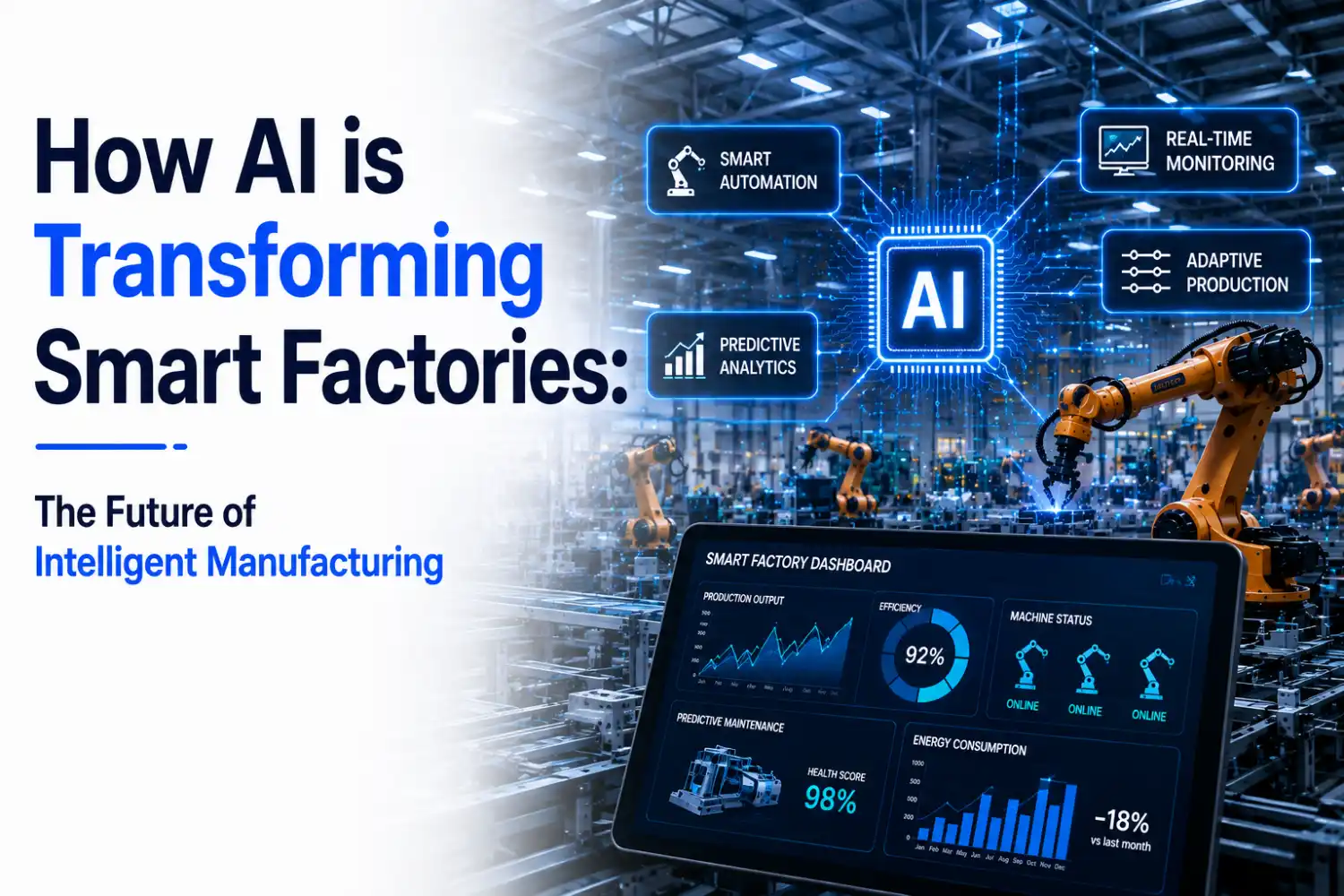
How AI is Transforming Smart Factories: The Future of Intelligent Manufacturing
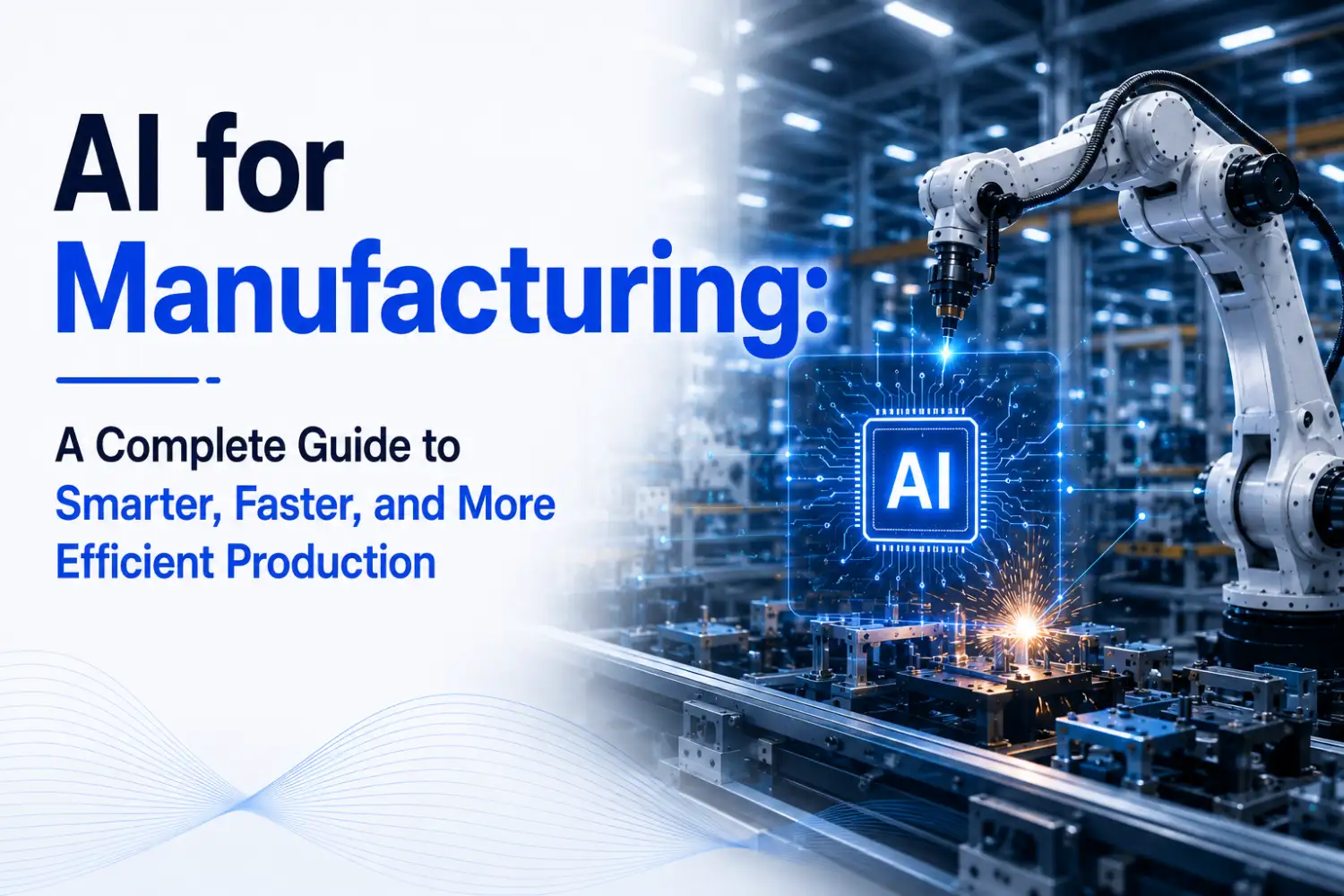
The manufacturing industry is experiencing one of its biggest transformations since the Industrial Revolution. Smart factories—powered by Artificial Intelligence (AI), Industrial IoT (IIoT), robotics, and data analytics—are reshaping how products are designed, manufactured, inspected, and delivered.
Unlike traditional factories that rely heavily on manual processes and reactive decision-making, smart factories leverage AI to automate operations, optimize production, reduce downtime, and improve product quality in real time.
As manufacturers face increasing pressure to reduce costs, improve efficiency, and meet customer demands, AI has become a key driver of innovation. Organizations that embrace AI-powered smart manufacturing are gaining a competitive edge through increased productivity, greater operational visibility, and enhanced flexibility.
In this comprehensive guide, we'll explore how AI is transforming smart factories, the technologies behind this revolution, real-world applications, implementation strategies, and why businesses should invest in AI-driven manufacturing solutions.
What Is a Smart Factory?
A smart factory is a digitally connected manufacturing facility where machines, sensors, software systems, and production equipment continuously communicate with each other. By integrating AI, Industrial Internet of Things (IIoT), cloud computing, and advanced analytics, smart factories can monitor operations, automate decisions, and optimize production with minimal human intervention.
Unlike conventional factories, smart factories can:
- Monitor production in real time
- Detect equipment failures before they occur
- Automate repetitive tasks
- Improve product quality
- Optimize resource utilization
- Adapt production schedules based on demand
- Reduce waste and energy consumption
The result is a highly efficient, flexible, and data-driven manufacturing environment.
Why AI Is Essential for Smart Factories
Modern manufacturing generates enormous amounts of data every second—from production lines, machines, robots, sensors, quality inspections, and enterprise systems.
Without AI, analyzing this volume of data is nearly impossible.
Artificial Intelligence enables manufacturers to:
- Analyze millions of data points instantly
- Detect hidden production patterns
- Predict equipment failures
- Recommend operational improvements
- Automate decision-making
- Continuously optimize manufacturing processes
Rather than replacing workers, AI empowers employees with actionable insights, allowing them to focus on higher-value tasks while automation handles repetitive processes.
Key Technologies Powering AI-Driven Smart Factories
Artificial Intelligence & Machine Learning
Machine learning algorithms analyze historical and real-time production data to identify trends, optimize workflows, and improve decision-making.
Applications include:
- Demand forecasting
- Equipment health monitoring
- Process optimization
- Quality prediction
- Production scheduling
Industrial Internet of Things (IIoT)
IIoT devices connect machines, sensors, and equipment across the factory floor.
These devices continuously collect data such as:
- Temperature
- Pressure
- Vibration
- Machine speed
- Energy usage
- Production output
AI uses this data to make intelligent operational decisions.
Computer Vision
AI-powered cameras inspect products with exceptional speed and accuracy.
Computer vision enables:
- Defect detection
- Surface inspection
- Barcode verification
- Component recognition
- Packaging inspection
- Worker safety monitoring
Manufacturers can significantly reduce defects while maintaining consistent quality.
Robotics and Cobots
Modern factories increasingly use intelligent robots capable of learning and adapting.
Applications include:
- Welding
- Assembly
- Packaging
- Material handling
- Machine loading
- Quality inspection
Collaborative robots (Cobots) work safely alongside human workers, improving productivity without replacing human expertise.
Edge Computing
Processing AI models directly on factory equipment enables real-time decision-making with minimal latency.
Benefits include:
- Faster response times
- Reduced cloud dependency
- Improved operational reliability
- Lower network traffic
Cloud Computing
Cloud platforms store production data, enable remote monitoring, and support scalable AI applications across multiple manufacturing facilities.
How AI Is Transforming Smart Factories
Predictive Maintenance
Equipment failures are one of the biggest causes of production downtime.
AI continuously monitors machine performance using sensor data and predicts failures before they happen.
Benefits include:
- Reduced downtime
- Lower maintenance costs
- Extended equipment life
- Better maintenance scheduling
Manufacturers shift from reactive repairs to proactive maintenance strategies.
Intelligent Quality Control
Traditional quality inspection often depends on manual checks.
AI-powered computer vision automates inspections by identifying:
- Surface scratches
- Incorrect dimensions
- Missing parts
- Color inconsistencies
- Packaging defects
This improves product quality while reducing inspection time and human error.
Production Line Optimization
AI analyzes production data in real time to identify bottlenecks, optimize machine utilization, and balance workloads across production lines.
Results include:
- Higher throughput
- Faster production cycles
- Reduced idle time
- Better equipment utilization
Smart Inventory Management
AI predicts inventory requirements using:
- Historical sales
- Market trends
- Production schedules
- Supplier performance
Manufacturers avoid stock shortages while minimizing excess inventory.
Supply Chain Optimization
AI improves supply chain resilience by forecasting demand, monitoring supplier risks, optimizing logistics, and identifying disruptions before they impact production.
Energy Management
Manufacturing facilities consume significant energy.
AI analyzes energy usage patterns and recommends optimization strategies.
Benefits include:
- Lower utility costs
- Reduced carbon emissions
- Improved sustainability
- Efficient equipment operation
Worker Safety
AI enhances workplace safety through intelligent monitoring systems.
Examples include:
- PPE detection
- Restricted zone monitoring
- Fall detection
- Hazard identification
- Real-time safety alerts
These systems help create safer industrial environments while reducing workplace accidents.
Real-World Applications Across Industries
Automotive Manufacturing
AI enables predictive maintenance, robotic assembly, automated welding, paint inspection, and quality assurance.
Electronics Manufacturing
Manufacturers use AI for precision assembly, PCB inspection, automated testing, and defect detection.
Food & Beverage
AI optimizes production schedules, monitors food quality, predicts equipment maintenance, and reduces waste.
Pharmaceutical Manufacturing
Applications include batch monitoring, packaging inspection, regulatory compliance, and production optimization.
Aerospace
AI improves precision manufacturing, aircraft component inspection, predictive maintenance, and supply chain visibility.
Heavy Machinery
Manufacturers leverage AI for equipment diagnostics, fleet monitoring, predictive maintenance, and process optimization.
Benefits of AI-Powered Smart Factories
Organizations implementing AI experience measurable improvements across operations.
Increased Productivity
Automation enables higher production output with fewer interruptions.
Improved Product Quality
AI-powered inspection systems consistently detect defects more accurately than manual inspections.
Reduced Operational Costs
Predictive maintenance, optimized resource allocation, and automation significantly lower operating expenses.
Faster Decision-Making
Real-time analytics provide managers with instant operational insights.
Enhanced Flexibility
AI enables manufacturers to adapt production schedules based on changing customer demand.
Greater Sustainability
Optimized energy usage and waste reduction contribute to more sustainable manufacturing practices.
Challenges of Implementing AI in Smart Factories
Despite its advantages, AI adoption requires careful planning.
Legacy Equipment Integration
Older machines may require IoT sensors and system upgrades before AI can be implemented.
Data Quality
Accurate AI models depend on clean, structured, and reliable production data.
Workforce Training
Employees need training to effectively use AI-powered systems and interpret analytics.
Cybersecurity
Connected manufacturing environments require strong security measures to protect operational technology and business data.
Initial Investment
AI implementation involves investments in infrastructure, software, sensors, and integration. However, long-term productivity gains often deliver a strong return on investment.
Best Practices for Implementing AI in Smart Factories
A successful AI strategy involves more than deploying technology. Manufacturers should:
- Identify high-impact business challenges.
- Collect and organize production data.
- Start with a pilot project.
- Integrate AI with ERP, MES, and IoT systems.
- Measure key performance indicators (KPIs).
- Scale successful AI initiatives across the factory.
- Continuously improve AI models using new operational data.
A phased implementation minimizes risks while maximizing business value.
Future Trends in AI-Powered Smart Manufacturing
The next generation of smart factories will be driven by:
- Autonomous production systems
- AI-powered digital twins
- Generative AI for production planning
- Advanced collaborative robots (Cobots)
- Real-time predictive analytics
- Self-optimizing production lines
- Sustainable manufacturing powered by AI
- AI-driven supply chain orchestration
- Hyper-automation across factory operations
These innovations will enable manufacturers to become more agile, resilient, and competitive in an increasingly digital economy.
Why Choose True Value Infosoft for AI Manufacturing Solutions?
At True Value Infosoft, we help manufacturers accelerate their digital transformation through custom AI-powered solutions designed for modern industrial environments.
Our expertise includes:
- AI Strategy & Manufacturing Consulting
- Custom AI Solution Development
- Machine Learning Model Development
- Computer Vision for Quality Inspection
- Predictive Maintenance Platforms
- Industrial IoT (IIoT) Integration
- Manufacturing Analytics Dashboards
- Intelligent Process Automation
- ERP & MES Integration
- Cloud-Based AI Applications
Our team works closely with manufacturers to build scalable, secure, and intelligent solutions that improve operational efficiency, reduce costs, and enhance product quality.
Whether you're beginning your smart factory journey or expanding existing AI initiatives, we deliver tailored solutions aligned with your business goals.
Conclusion
Artificial Intelligence is redefining the future of manufacturing by transforming traditional factories into intelligent, connected, and highly efficient smart factories. Through predictive maintenance, computer vision, robotics, real-time analytics, and intelligent automation, AI enables manufacturers to improve productivity, reduce costs, enhance product quality, and make faster, data-driven decisions.
Businesses that invest in AI today are building resilient, future-ready operations capable of adapting to changing market demands and technological advancements.
Partnering with an experienced AI development company like True Value Infosoft ensures a smooth implementation journey—from strategy and development to deployment and ongoing optimization—helping manufacturers unlock the full potential of smart factory technologies.