Introduction
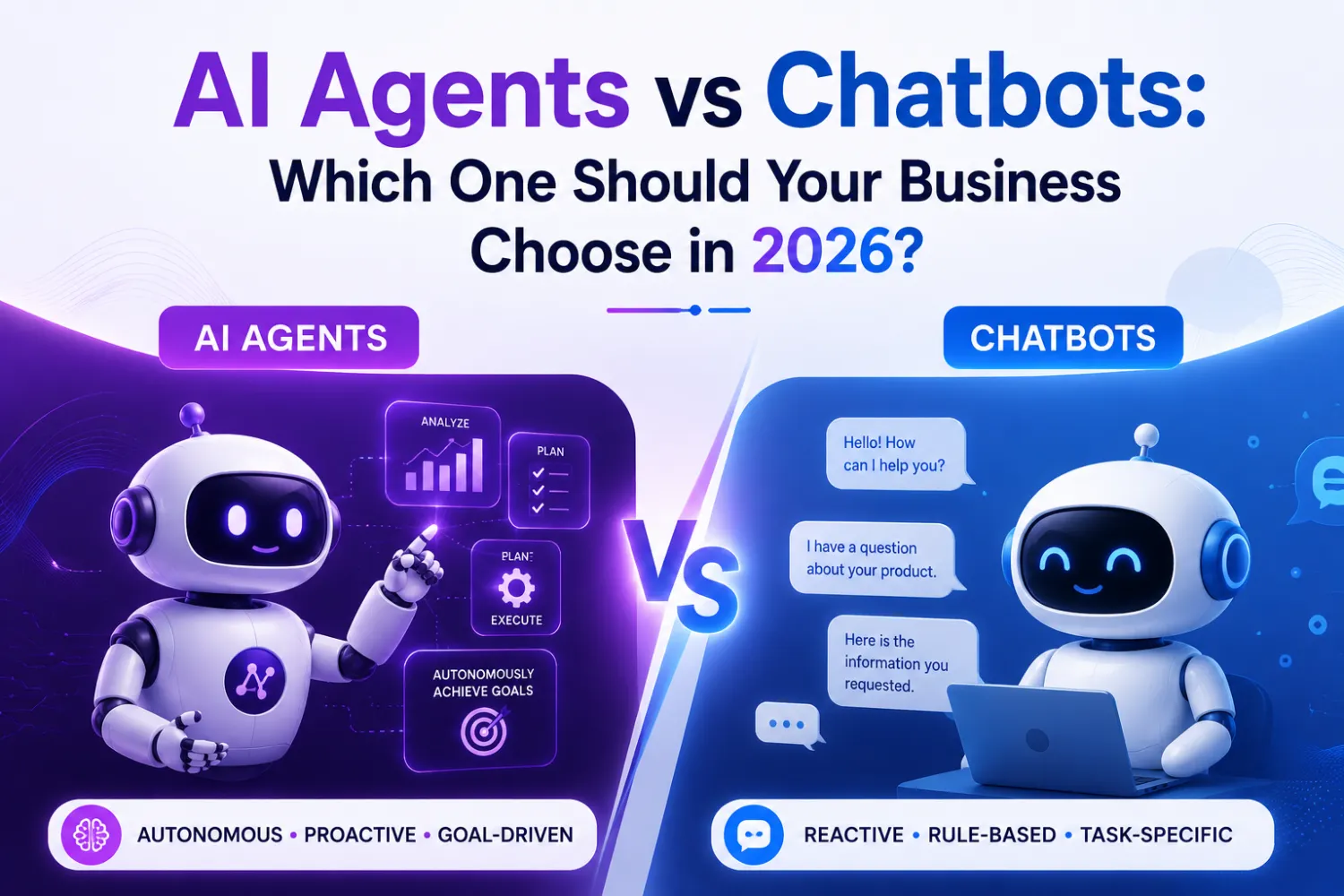
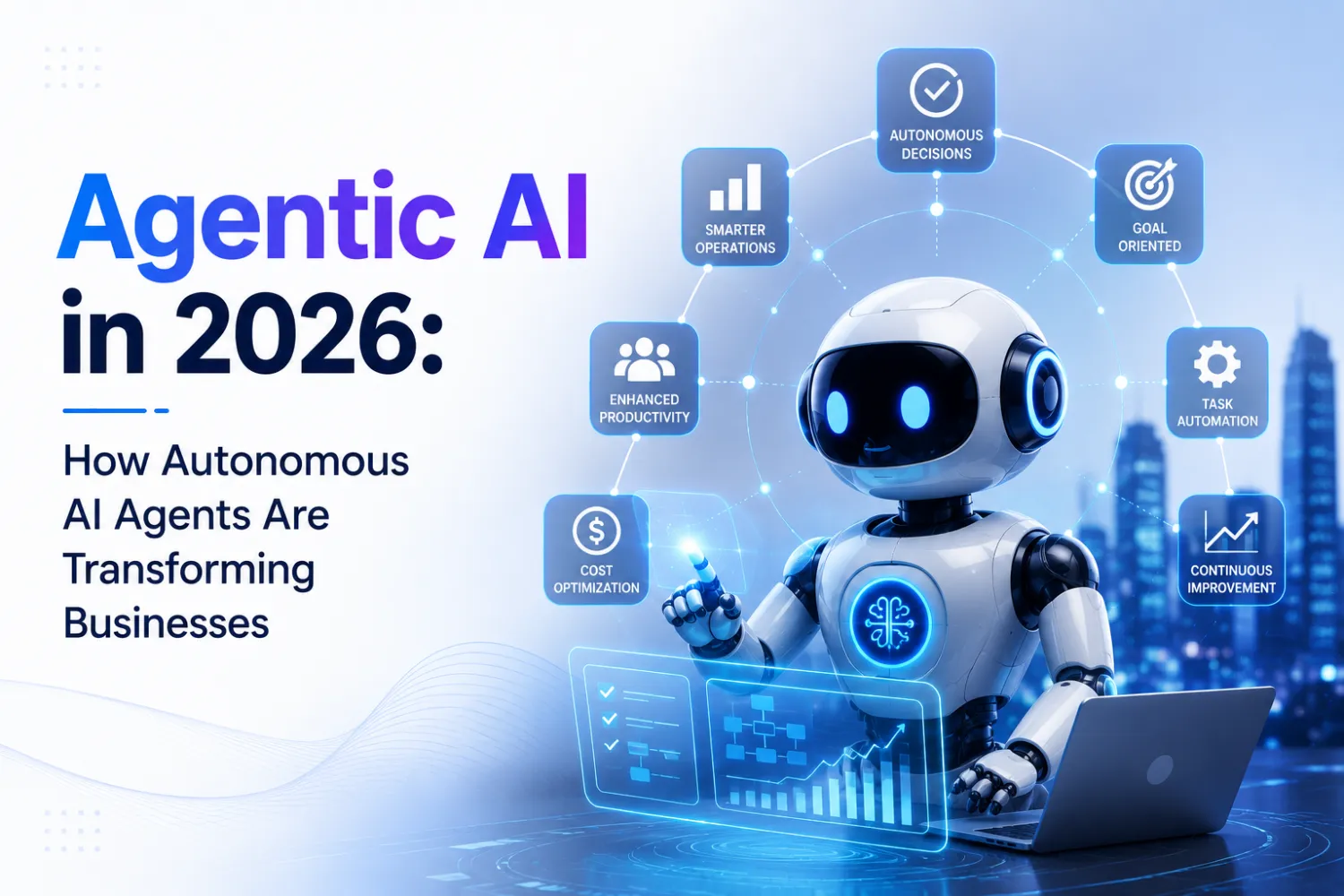
Artificial Intelligence is entering a new phase. Businesses are moving beyond AI systems that simply answer questions or generate content toward Agentic AI—AI systems designed to understand goals, plan actions, make decisions, use tools, and complete multi-step tasks with greater autonomy.
Traditional Generative AI typically waits for a user prompt and produces a response. Agentic AI goes further. An AI agent can receive an objective, determine the steps required, interact with business applications and data, execute actions, evaluate results, and continue working toward the desired outcome.
For businesses, this shift has major implications. AI is evolving from a productivity assistant into a technology capable of participating directly in business workflows.
In this guide, we'll explore what Agentic AI is, how autonomous AI agents work, their major business use cases, benefits, challenges, and how companies can prepare for the growing adoption of AI agents in 2026.
What Is Agentic AI?
Agentic AI refers to artificial intelligence systems that can pursue goals and perform tasks with a degree of autonomy.
Instead of requiring detailed instructions for every individual action, an agent can interpret a broader objective and determine how to achieve it.
For example, rather than asking an AI system to simply draft a sales follow-up email, an AI sales agent could potentially:
- Identify leads requiring follow-up
- Review previous conversations
- Analyse CRM information
- Determine the appropriate next action
- Personalise a follow-up message
- Send or prepare the message for approval
- Update the CRM
- Schedule the next activity
The exact level of autonomy depends on how the system is designed, what tools it can access, and which actions require human approval.
How Does Agentic AI Work?
Agentic AI typically combines Large Language Models (LLMs), business data, APIs, automation tools, memory, reasoning capabilities, and predefined rules or guardrails.
A typical AI agent workflow can include:
1. Understand the Goal
The agent receives an objective, such as qualifying new sales leads or resolving a customer support request.
2. Create a Plan
The AI determines which steps, information, and tools are required to complete the task.
3. Access Relevant Information
It retrieves information from authorised sources such as databases, CRMs, documents, APIs, or enterprise applications.
4. Take Actions
Depending on its permissions, the agent may update records, generate documents, send messages, trigger workflows, or interact with other software.
5. Evaluate the Result
The system checks whether its actions have moved it closer to the desired outcome.
6. Continue or Escalate
The agent can continue to the next step or involve a human when approval, judgement, or intervention is required.
This ability to move through multi-step workflows is one of the biggest differences between agentic systems and conventional AI assistants.
Agentic AI vs Generative AI
Although the technologies are closely connected, they aren't identical.
| Feature | Generative AI | Agentic AI |
|---|---|---|
| Primary Function | Generate content | Achieve goals and execute tasks |
| User Interaction | Usually prompt-based | Goal-oriented |
| Decision Making | Limited | More autonomous |
| Multi-Step Tasks | Limited without orchestration | Core capability |
| Tool Usage | Possible | Central to many agent workflows |
| Workflow Automation | Basic to moderate | Advanced |
| Human Intervention | Often required | Can be reduced with guardrails |
| Business Application | Content and assistance | Process execution and automation |
Generative AI can therefore be an important component inside an AI agent, while the agent adds planning, tool use, workflow logic, memory, and action-taking capabilities.
Why Agentic AI Matters for Businesses in 2026
The biggest opportunity isn't simply generating more content. It is connecting AI with real business processes.
Companies can use autonomous AI agents to reduce repetitive work, accelerate decision-making, improve response times, and coordinate workflows across multiple systems.
Instead of employees manually switching between email, CRM software, spreadsheets, analytics platforms, and other applications, agents can potentially coordinate parts of these workflows automatically.
This allows teams to spend more time on strategy, relationships, creativity, and complex decisions that require human expertise.
Top Agentic AI Use Cases for Businesses
1. AI Agents for Customer Support
Customer service is one of the strongest potential applications for Agentic AI.
An AI agent can go beyond answering FAQs. With appropriate permissions and integrations, it can understand a customer's problem, retrieve account information, check previous interactions, access a knowledge base, and perform approved actions.
Potential applications include:
- Resolving support requests
- Checking order information
- Processing eligible requests
- Updating customer records
- Creating support tickets
- Escalating complex cases
This can help businesses provide faster and more consistent customer experiences.
2. AI Agents for Sales
Sales teams spend considerable time on administrative work.
AI sales agents can support teams by automating tasks such as:
- Lead research
- Lead qualification
- CRM updates
- Follow-up preparation
- Meeting scheduling
- Sales summaries
- Pipeline monitoring
Agents can also analyse previous interactions and customer data to help sales teams determine which opportunities require attention.
3. Marketing Automation
Agentic AI can coordinate marketing activities across multiple tools and data sources.
Marketing agents can potentially:
- Research topics
- Analyse campaign performance
- Generate content ideas
- Segment audiences
- Personalise communications
- Prepare reports
- Recommend campaign improvements
Human oversight remains important for brand strategy, creative decisions, accuracy, and campaign approvals.
4. Human Resources and Recruitment
AI agents can automate repetitive administrative tasks throughout recruitment and employee operations.
Applications include:
- Candidate screening assistance
- Interview scheduling
- Candidate communication
- Employee onboarding
- Document processing
- HR knowledge assistance
- Internal request management
Agentic workflows can connect applicant tracking systems, calendars, email, HR software, and internal databases to reduce repetitive coordination.
5. Finance and Accounting
Finance teams can use AI agents to assist with structured, repetitive workflows.
Examples include:
- Invoice processing
- Expense categorisation
- Document verification
- Payment reconciliation
- Financial report preparation
- Data extraction
- Compliance workflow assistance
High-impact financial decisions and sensitive transactions should still include appropriate controls and human approval.
6. Software Development
Agentic AI is also changing software development.
AI coding agents can assist developers with:
- Code generation
- Bug identification
- Test creation
- Documentation
- Code analysis
- Development task planning
- Refactoring assistance
More advanced systems can work through multiple stages of a development task rather than generating only individual code snippets.
7. IT Operations
IT teams manage large numbers of repetitive requests, alerts, and system events.
AI agents can help with:
- Ticket classification
- Incident investigation
- System monitoring
- Knowledge retrieval
- Routine troubleshooting
- Report generation
- Escalation workflows
This can reduce repetitive work while helping IT teams respond to issues more quickly.
8. E-commerce Operations
Agentic AI can help online businesses coordinate customer, inventory, and operational workflows.
Potential applications include:
- Product recommendations
- Customer support
- Order assistance
- Inventory alerts
- Product information management
- Customer engagement
- Sales analysis
Combined with business APIs and commerce platforms, AI agents can become an intelligent automation layer across e-commerce operations.
Multi-Agent Systems: The Next Stage of Agentic AI
One important development is the rise of multi-agent systems.
Instead of relying on a single AI agent to perform everything, businesses can create specialised agents responsible for different tasks.
For example, a sales operation could use:
Research Agent → Qualification Agent → Outreach Agent → CRM Agent → Reporting Agent
These agents can exchange information and coordinate activities to complete a larger workflow.
This approach can make complex automation more modular, with individual agents designed around specific responsibilities and permissions.
Benefits of Agentic AI for Businesses
Increased productivity
AI agents can handle repetitive digital tasks while employees focus on higher-value activities.
End-to-End Workflow Automation
Agents can connect multiple stages of a business process rather than automating only one isolated task.
Faster Decision Support
AI can analyse large amounts of authorised business information and surface relevant insights quickly.
24/7 Operations
Certain automated workflows can continue outside normal working hours.
Improved Customer Experience
Faster responses and more contextual interactions can improve customer service.
Scalability
Businesses can automate growing workloads without increasing manual effort at the same rate.
Better Use of Business Data
AI agents can retrieve and analyse information across connected systems, helping organisations make better use of existing data.
Challenges of Implementing Agentic AI
Agentic AI creates powerful opportunities, but autonomy also introduces new risks.
Security and Access Control
Agents should only have access to the information and systems necessary for their tasks.
Data Privacy
Organisations need appropriate controls around how customer, employee, and business data is accessed and processed.
AI Reliability
AI-generated reasoning and outputs can be incorrect. Critical actions therefore require validation, monitoring, and appropriate human oversight.
System Integration
Enterprise agents may need to connect with CRMs, ERPs, databases, APIs, cloud platforms, and legacy software.
Governance
Businesses need clear policies defining what agents can do autonomously and which actions require human approval.
Monitoring
Agent actions should be logged and observable so organisations can understand what occurred and investigate failures.
Best Practices for Implementing AI Agents
Businesses shouldn't begin by trying to automate everything.
A stronger approach is to identify a well-defined process where automation can deliver measurable value.
Start with repetitive, high-volume workflows that have clear rules and outcomes. Define what information the agent can access, which actions it can perform, and when human approval is mandatory.
Businesses should also implement:
- Role-based access controls
- Human-in-the-loop approvals
- Activity logging
- Data protection controls
- Testing and evaluation
- Performance monitoring
- Clear escalation procedures
Once the initial workflow performs reliably, the organisation can gradually expand its agentic AI capabilities.
Will AI Agents Replace Employees?
AI agents are more likely to change how many jobs are performed than simply eliminate the need for people across entire organisations.
Routine digital tasks can increasingly be automated, while employees can focus on activities requiring judgement, creativity, relationship-building, accountability, and strategic thinking.
The emerging model is therefore likely to involve humans and AI agents working together, with businesses determining the right level of autonomy for each workflow.
Future of Agentic AI
Agentic AI is moving towards systems that can coordinate increasingly complex tasks across applications and business functions.
We can expect continued development around:
- Multi-agent systems
- Enterprise AI agents
- AI-powered digital workers
- Autonomous workflow automation
- Industry-specific AI agents
- Voice-based agents
- AI coding agents
- Agent governance and security
- Human-AI collaboration
The organisations that benefit most won't necessarily be those deploying the largest number of agents. They will be those that connect AI to valuable business processes while maintaining strong security, governance, measurement, and human oversight.
How True Value Infosoft Helps Businesses Build Agentic AI Solutions
At True Value Infosoft, we help businesses design and develop intelligent AI solutions tailored to real-world business requirements.
Our capabilities include:
- AI Agent Development
- Multi-Agent AI Systems
- Generative AI Development
- AI Chatbot Development
- Machine Learning Solutions
- Intelligent Process Automation
- Custom Software Development
- LLM Integration
- RAG Solutions
- CRM & ERP Integration
- Enterprise AI Solutions
Whether you want to automate customer support, sales, recruitment, internal operations, or complex enterprise workflows, our team can help build scalable AI solutions that integrate with your existing technology ecosystem.
Conclusion
Agentic AI represents an important evolution in business automation. Instead of simply responding to prompts, autonomous AI agents can understand objectives, plan tasks, interact with software, and execute multi-step workflows.
From sales and customer support to HR, finance, software development, and IT operations, AI agents have the potential to transform how organisations manage digital work.
However, successful adoption requires more than connecting an LLM to business software. Security, data privacy, system integration, governance, monitoring, and human oversight all need to be considered from the beginning.
As Agentic AI continues to mature in 2026, businesses that identify the right use cases and implement the technology responsibly can create faster, more scalable, and more intelligent operations.
True Value Infosoft can help businesses design, develop, and integrate custom Agentic AI solutions built around their workflows, systems, and business goals.