Introduction
The banking industry is undergoing one of the biggest technological transformations in its history. Customers expect instant account opening, real-time payments, personalized financial services, and 24/7 customer support. At the same time, banks face increasing regulatory compliance, operational costs, fraud risks, and intense competition from fintech companies.
Traditional manual processes are no longer sufficient to meet these demands.
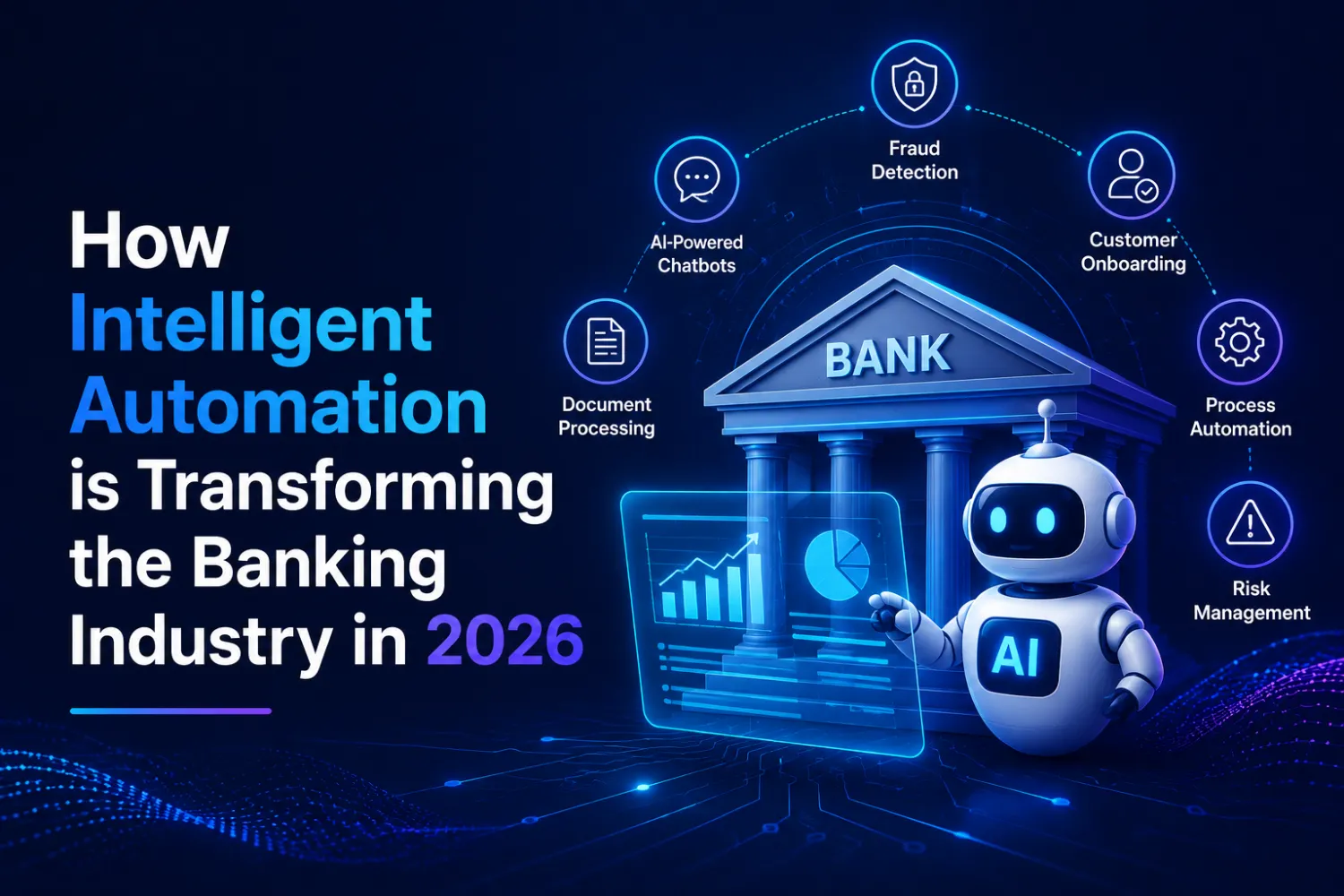
This is where Intelligent Automation (IA) is making a significant impact. By combining Artificial Intelligence (AI), Robotic Process Automation (RPA), Machine Learning (ML), Natural Language Processing (NLP), and Intelligent Document Processing (IDP), banks can automate repetitive operations while improving decision-making and customer experiences.
At True Value Infosoft, we help banks, NBFCs, and fintech organizations build secure, scalable, and AI-powered automation solutions tailored to modern banking needs. With over 15 years of software development experience and hundreds of successful projects, we specialize in enterprise-grade digital transformation solutions.
What is Intelligent Automation in Banking?
Intelligent Automation refers to the combination of AI technologies and business process automation to handle both structured and unstructured banking operations.
Unlike traditional automation, Intelligent Automation can:
- Understand documents
- Make decisions using AI
- Detect fraud patterns
- Learn from historical data
- Automate customer interactions
- Improve continuously over time
Instead of replacing employees, IA enables banking professionals to focus on strategic and customer-facing activities.
Why Banks Need Intelligent Automation
Banks process millions of transactions every day.
These include:
- Loan applications
- KYC verification
- Customer onboarding
- Account opening
- Payment processing
- Compliance reporting
- Fraud monitoring
- Customer service
Managing these manually leads to:
- Higher operational costs
- Human errors
- Slow processing
- Compliance risks
- Poor customer experience
Intelligent Automation addresses these challenges by delivering faster, more accurate, and scalable operations.
Core Technologies Behind Intelligent Banking Automation
Artificial Intelligence (AI)
AI helps banks make predictions, automate decisions, detect fraud, and personalize customer services.
Robotic Process Automation (RPA)
Software bots automate repetitive rule-based activities like data entry, report generation, reconciliation, and account processing.
Machine Learning
ML models identify fraud, predict customer behavior, and improve lending decisions using historical data.
Natural Language Processing (NLP)
Enables AI chatbots, virtual banking assistants, email automation, and voice banking.
Intelligent Document Processing (IDP)
Automatically extracts information from:
- Aadhaar
- PAN
- Passports
- Income proofs
- Bank statements
- Loan documents
OCR Technology
Converts scanned banking documents into structured digital data.
Enterprise Use Cases of Intelligent Automation in Banking
1. Customer Onboarding
Banks can automate:
- KYC verification
- Identity validation
- Document verification
- Risk assessment
- Account creation
This reduces onboarding from several days to just a few minutes.
2. Loan Processing Automation
Automation can handle:
- Credit scoring
- Income verification
- Document extraction
- Eligibility checks
- Approval workflows
This significantly reduces loan approval times.
3. Fraud Detection
AI continuously monitors transactions to detect:
- Suspicious activities
- Identity theft
- Unusual payment behavior
- Money laundering risks
4. KYC and Compliance Automation
Automation helps banks comply with RBI, AML, and regulatory requirements by automatically validating customer documents and maintaining audit trails.
5. Customer Support Automation
AI-powered chatbots can answer:
- Balance inquiries
- Loan status
- Card blocking
- Transaction history
- EMI information
- Branch details
24 hours a day.
6. Payment Processing
Banks automate:
- Payment validation
- Reconciliation
- Settlement
- Exception handling
Improving speed while reducing manual intervention.
7. Document Management
Thousands of banking documents can be automatically classified, extracted, indexed, and stored securely.
8. Credit Risk Analysis
Machine learning models evaluate:
- Credit history
- Financial behavior
- Income patterns
- Spending trends
to improve lending accuracy.
9. Claims Processing
Insurance and bancassurance divisions can automate claim verification and settlement.
10. Financial Reporting
Automation generates:
- RBI reports
- Audit reports
- Compliance reports
- Risk dashboards
with minimal manual effort.
Benefits of Intelligent Automation in Banking
Faster Operations
Processes that once took days can now be completed within minutes.
Lower Operational Costs
Banks reduce repetitive manual work and optimize workforce productivity.
Better Customer Experience
Customers receive faster responses, quicker approvals, and 24/7 service.
Improved Accuracy
Automation minimizes human errors in financial operations.
Stronger Compliance
Automated audit trails simplify regulatory reporting and inspections.
Enhanced Fraud Detection
AI continuously monitors transactions and identifies suspicious patterns in real time.
Scalability
Banks can manage growing transaction volumes without proportionally increasing operational staff.
Challenges in Implementing Intelligent Automation
While the benefits are significant, banks may face challenges such as:
- Legacy banking systems
- Data quality issues
- Regulatory compliance
- Cybersecurity concerns
- Employee adoption
- Integration complexity
A phased implementation approach helps mitigate these risks.
Best Practices for Successful Implementation
- Identify high-volume repetitive processes.
- Define measurable business objectives.
- Start with pilot automation projects.
- Integrate AI with existing banking systems.
- Ensure RBI and data security compliance.
- Train employees alongside automation initiatives.
- Continuously monitor and optimize automated workflows.
Future of Intelligent Automation in Banking
The next generation of banking automation will include:
- AI Agents for banking operations
- Hyperautomation
- Autonomous loan processing
- Voice-enabled banking
- Predictive financial advisory
- Generative AI-powered customer support
- Real-time risk intelligence
- Personalized banking experiences
Banks that invest early in intelligent automation will be better positioned to improve operational efficiency and deliver exceptional customer experiences.
Why Choose True Value Infosoft?
True Value Infosoft develops enterprise-grade banking automation solutions that combine AI, automation, cloud technologies, and secure software engineering.
Our capabilities include:
- AI Banking Solutions
- Custom Banking Software
- RPA Development
- AI Agent Development
- Intelligent Document Processing
- Enterprise Workflow Automation
- Banking CRM Solutions
- API Integration
- Mobile Banking Applications
- Cloud-based Banking Platforms
Whether you're a bank, NBFC, fintech startup, or financial institution, we can build scalable automation solutions tailored to your business goals.
Conclusion
Intelligent Automation is reshaping the banking industry by improving efficiency, reducing costs, enhancing compliance, and delivering better customer experiences. By leveraging AI, RPA, ML, and intelligent document processing, banks can automate complex workflows while maintaining security and regulatory standards.
Organizations that adopt intelligent automation today will be better prepared for the future of digital banking. Partnering with an experienced technology company like True Value Infosoft can help accelerate this transformation with scalable, secure, and customized enterprise solutions.