AI Agents vs Chatbots: What's the Difference and Which Is Better for Your Business?
Artificial Intelligence is transforming how businesses interact with customers, automate workflows, and improve operational efficiency. Two of the most talked-about AI technologies today are AI Chatbots and AI Agents. While both automate conversations and reduce manual work, they are designed for very different purposes.
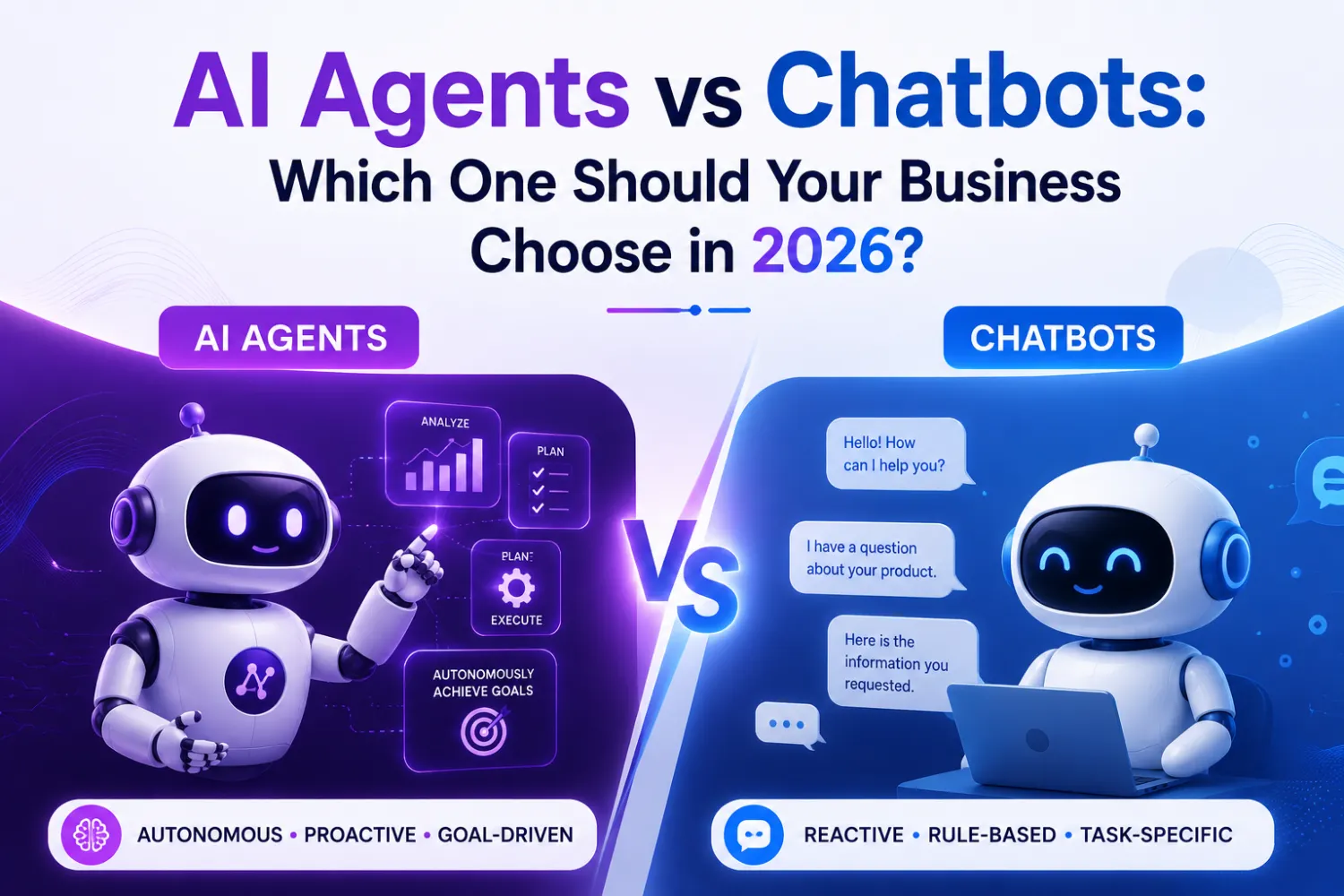
Many businesses assume AI Agents and Chatbots are the same, but that's far from the truth. Traditional chatbots follow predefined rules and scripted conversations, whereas AI Agents can reason, make decisions, execute tasks, and continuously learn from interactions.
So, which one is right for your business?
In this guide, we'll compare AI Agents and Chatbots, explore their features, benefits, real-world use cases, and help you decide which solution best fits your business goals.
What Is an AI Chatbot?
An AI Chatbot is a software application designed to simulate conversations with users through text or voice. Modern AI chatbots use Natural Language Processing (NLP) and Large Language Models (LLMs) to understand questions and generate relevant responses.
Chatbots are commonly used for:
- Customer support
- FAQs
- Appointment booking
- Lead generation
- Product recommendations
- Order tracking
They help businesses provide instant responses and improve customer engagement while reducing support costs.
What Is an AI Agent?
An AI Agent is a more advanced AI system capable of understanding goals, planning actions, making decisions, and completing multi-step tasks with minimal human intervention.
Unlike chatbots, AI Agents don't just answer questions—they perform actions.
An AI Agent can:
- Analyze data
- Access business applications
- Automate workflows
- Generate reports
- Schedule meetings
- Send emails
- Manage CRM updates
- Integrate with multiple software platforms
AI Agents act like intelligent digital employees that work autonomously to complete business processes.
AI Agents vs Chatbots: Key Differences
| Feature | AI Chatbots | AI Agents |
|---|---|---|
| Primary Purpose | Answer questions | Complete tasks |
| Decision Making | Limited | Advanced |
| Workflow Automation | Basic | End-to-end |
| Learning Capability | Moderate | Continuous |
| Business Integrations | Limited | Extensive |
| Multi-Step Tasks | No | Yes |
| Context Awareness | Basic | Advanced |
| Human Intervention | Frequent | Minimal |
When Should You Use an AI Chatbot?
AI Chatbots are ideal for businesses that need:
- Customer support automation
- Frequently asked questions
- Lead qualification
- Appointment scheduling
- Product information
- Order status inquiries
They are easy to deploy and provide quick value for customer-facing operations.
When Should You Use an AI Agent?
AI Agents are better suited for businesses that need intelligent automation across departments.
Common use cases include:
Sales Automation
AI Agents qualify leads, update CRM systems, schedule follow-ups, and generate sales reports.
Customer Support Automation
They resolve complex customer issues by accessing multiple business systems and executing workflows.
HR Automation
AI Agents assist with employee onboarding, leave management, payroll queries, and document verification.
Finance & Accounting
They automate invoice processing, expense approvals, financial reporting, and compliance tasks.
IT Operations
AI Agents monitor systems, create support tickets, troubleshoot issues, and automate repetitive IT processes.
Benefits of AI Chatbots
- Quick deployment
- Lower implementation cost
- 24/7 customer support
- Improved customer engagement
- Faster response times
- Reduced support workload
Benefits of AI Agents
- Intelligent decision-making
- End-to-end workflow automation
- Increased productivity
- Reduced operational costs
- Better business efficiency
- Continuous learning
- Personalized customer experiences
- Seamless software integration
Real-World Examples
AI Chatbot Example
An e-commerce website uses a chatbot to answer product questions, track orders, and collect customer inquiries.
AI Agent Example
A financial services company deploys an AI Agent that receives loan applications, verifies documents, checks eligibility, updates CRM records, sends approval emails, and schedules follow-up calls—all without human intervention.
AI Chatbots vs AI Agents: Which Is Better?
The answer depends on your business requirements.
Choose an AI Chatbot if your goal is to improve customer communication and automate simple conversations.
Choose an AI Agent if you want to automate business processes, improve productivity, and enable intelligent decision-making across multiple systems.
Many organizations successfully use both technologies together—chatbots handle customer conversations while AI Agents perform the underlying business tasks.
Future of AI Agents
As Generative AI continues to evolve, AI Agents are becoming more autonomous, collaborative, and capable of handling increasingly complex workflows.
Future AI Agents will:
- Work across multiple applications
- Collaborate with other AI systems
- Make intelligent business decisions
- Automate end-to-end operations
- Deliver hyper-personalized customer experiences
Businesses investing in AI Agents today are positioning themselves for the next generation of digital transformation.
How True Value Infosoft Helps Businesses Build AI Solutions
At True Value Infosoft, we help businesses adopt AI technologies that improve efficiency, automate operations, and enhance customer experiences.
Our expertise includes:
- AI Agent Development
- AI Chatbot Development
- Generative AI Solutions
- Machine Learning Development
- Intelligent Process Automation
- Custom Software Development
- CRM & ERP Integration
- AI Consulting
- Enterprise AI Solutions
- Cloud-Based AI Applications
Whether you're looking to deploy an AI Chatbot for customer support or build intelligent AI Agents for workflow automation, our team delivers secure, scalable, and customized AI solutions tailored to your business needs.
Conclusion
Both AI Chatbots and AI Agents play an important role in modern business automation, but they serve different purposes. Chatbots excel at handling customer interactions and answering questions, while AI Agents go a step further by making decisions, automating workflows, and completing complex tasks.
As businesses continue their digital transformation journey, combining AI Chatbots with AI Agents can unlock greater efficiency, improve customer experiences, and drive long-term growth.
If you're ready to build intelligent AI solutions, True Value Infosoft can help you develop scalable AI Chatbots and AI Agents tailored to your business objectives.